Lyab-i-Hauz in Bukhara: History, Madrasahs and Khoja Nasreddin
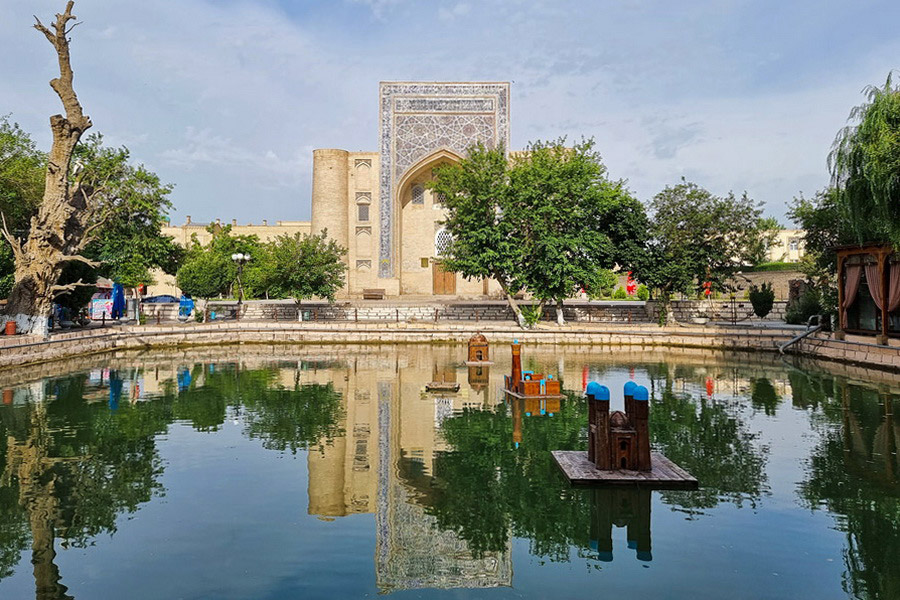
In the heart of historic Bukhara lies a small pool, around which an entire architectural ensemble has grown: the Kukeldash Madrasah, the Nadir Divan-Beghi Khanaka, and the Nadir Divan-Beghi Madrasah. Today the square is home to cafés and restaurants, cultural events take place here, and beside the water stands the famous statue of Khoja Nasreddin.
For a traveler, this is one of the best places not just to look at Bukhara, but to feel its atmosphere. And it's exactly here that our walking tour of Bukhara's old town begins.
What the name Lyab-i-Hauz means
The name "Lyab-i-Hauz" is usually translated as "by the pool" or "at the pond."
A hauz is an artificial pool that in old Bukhara served not only a decorative but also a practical purpose. The city had a complex network of canals and irrigation ditches, and large pools served as water reserves.
So in old Bukhara, a hauz was an important part of city life.
It wasn't just a pond: people met here, rested after their travels, drew water, traded and socialized.
Today Lyab-i-Hauz no longer plays the role it did centuries ago, but the idea of the place has survived — it remains one of the old town's main gathering points.
How the Lyab-i-Hauz ensemble came to be
Unlike Registan in Samarkand, Lyab-i-Hauz wasn't created all at once.
The ensemble took shape gradually.
The first to appear here was the Kukeldash Madrasah — built in 1568–1569 by order of Abdullah Khan II. It's the oldest structure in the present-day ensemble.
Then, at the beginning of the 17th century, the pool itself appeared on the square, and the Nadir Divan-Beghi Khanaka was built.
The last of the three main structures was the Nadir Divan-Beghi Madrasah, built in 1622–1623.
So over the course of a few decades, the space we now call Lyab-i-Hauz took shape around the pool.
The Kukeldash Madrasah — the square's oldest building
On the northern side of the ensemble stands the Kukeldash Madrasah.
It was built as far back as the 16th century and is considered one of Bukhara's largest madrasahs. The building had around 160 khujras — cells for students.
The name is linked to the title "Kukeldash," held by the dignitary involved in its construction.
The madrasah's façade is far more restrained than that of the Nadir Divan-Beghi, but inside it conceals a complex that is enormous by old Bukhara's standards.
Standing by the water and looking at the Kukeldash, you can especially clearly see how closely architecture and everyday city life are intertwined here.
Today, tourists, cafés and craft stalls can be seen beside the ancient madrasah — much as the square has continued to be a meeting place for centuries.
The Nadir Divan-Beghi Khanaka
Facing the Nadir Divan-Beghi Madrasah stands the khanaka, built in 1619–1620.
A khanaka is a place tied to the Sufi tradition: dervishes, Sufis and travelers could stay and live here.
Together with the madrasah facing it, the building forms a so-called kosh — a composition of two structures facing one another.
The khanaka stands right at the water's edge, and together with the madrasah it creates one of Lyab-i-Hauz's most recognizable views.
The Nadir Divan-Beghi Madrasah: a building with an unexpected history
Perhaps the ensemble's most interesting building is the Nadir Divan-Beghi Madrasah.
Nadir Divan-Beghi originally built it as a caravanserai — a place for merchants and travelers to stop. But at the opening ceremony, Imamquli Khan declared it a madrasah. Nadir had to modify the already nearly finished building: adding a grand portal, loggias, corner towers and a second floor with khujras for students.
There's one remarkable detail: this madrasah never actually got a proper lecture hall — a darskhana. Its layout still bears the traces of its original purpose as a caravanserai.
The result was a peculiar architectural compromise — a building meant to be one thing that ended up becoming something else entirely.
Look closely at the Nadir Divan-Beghi's façade
This madrasah's façade is worth examining closely.
Its mosaics show images of birds, deer and a sun with a human face. Such figurative images are unusual for Islamic architecture, which is why the façade immediately stands out among Bukhara's other monuments.
It's especially rewarding to look at in the evening, when the lighting brings out the colors of the mosaic.
And if you've already seen the Sher-Dor Madrasah on the Registan, notice an interesting echo: both monuments feature images of animals and the sun.
Lyab-i-Hauz and the Great Silk Road
In medieval Bukhara, Lyab-i-Hauz stood right next to the bustling trade streets.
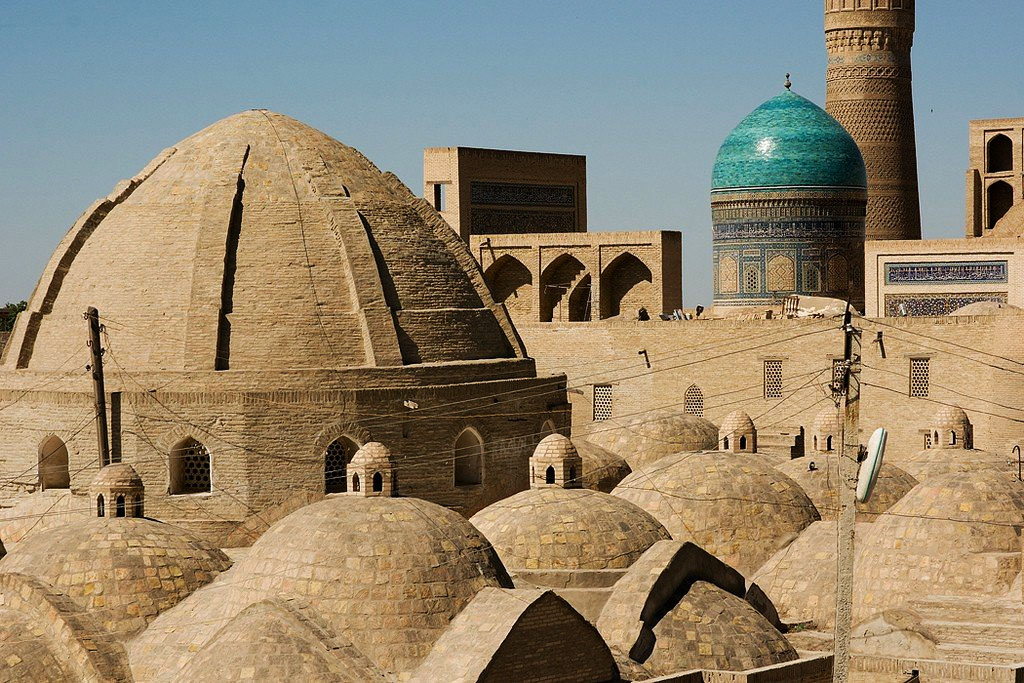
The square was a convenient open space amid the dense old town and lay close to the trading domes. Trade routes and human traffic crossed here.
It's not hard to picture this today.
Only instead of caravans and merchants, there are tourist tables, restaurants and souvenir stalls.
But the role of the place has barely changed: people still come here to pause in the middle of a walk.
How the hauz survived the Soviet era
In the 20th century, many of Bukhara's old pools were drained. Hauzes were considered a potential source of disease, since the water supply system and sanitary conditions remained problematic.
Lyab-i-Hauz survived thanks to the ensemble's artistic and historical value.
That's exactly why, today, in the center of old Bukhara, you can still see a genuine historic hauz.
It's a fairly rare case: a pool that was once part of everyday urban infrastructure has today become one of the city's calling cards.
Khoja Nasreddin by Lyab-i-Hauz
Beside the water, it's impossible to miss the unusual figure of a rider on a donkey.
This is Khoja Nasreddin — a legendary hero of Eastern folk tales, known for his wit, humor and love of unexpected solutions.
The bronze statue was installed here at the end of the 20th century. Today it's one of the most popular photo spots at Lyab-i-Hauz.
The statue has a special atmosphere of its own.
Walk past it and you'll see just a well-known sculpture. But if you know the stories of Nasreddin, it becomes clear why it fits so naturally right here.
Bukhara pairs surprisingly well with this character: a serious, ancient and majestic city that is at the same time very much alive.
Why Lyab-i-Hauz is one of the best places for an evening stroll
During the day Bukhara can get very hot, especially in summer.
That's why Lyab-i-Hauz is traditionally seen as a place to rest: the water, the shade of the trees, the open space and the cafés around it make it a convenient stop in the middle of a walk. Uzbekistan's official tourism resource also notes that today cafés operate around the hauz and various cultural events take place here.
And in the evening, the square changes.
By day, it's a good place to study the architecture.
By evening — to sit by the water, listen to music, watch the illuminated madrasahs, and simply observe the life of the city.
It's exactly at that moment that Lyab-i-Hauz shows especially well why Bukhara isn't just a collection of historical monuments.
🎧 Want to see Bukhara as more than a list of sights?
You can come to Lyab-i-Hauz, take a few photos and move on.
But it's far more interesting to learn why a hauz appeared here, who Nadir Divan-Beghi was, why one of the madrasahs was originally meant to be a caravanserai, and what connects Lyab-i-Hauz to Bukhara's old trading center.
On our Bukhara tour, we tell you all of this right during the walk.
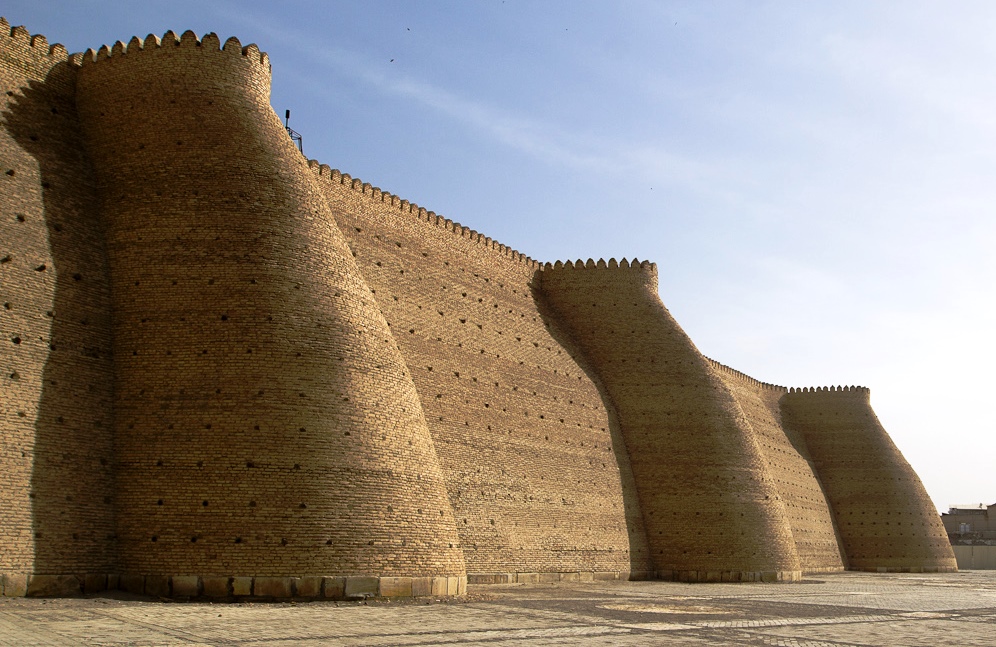
You walk through the old town with a local guide, hear the stories beside the monuments themselves, and gradually connect Lyab-i-Hauz with the Ark, the Kalyan minaret, the trading domes and other landmarks.
Bukhara becomes far more interesting once every building starts to have its own story.
Interesting facts about Lyab-i-Hauz
Lyab-i-Hauz means "by the pool." The name itself describes the ensemble's main feature — the historic hauz.
The ensemble's oldest building is the Kukeldash Madrasah. It was built in 1568–1569.
The Nadir Divan-Beghi Khanaka appeared around 1619–1620, and the Nadir Divan-Beghi Madrasah in 1622–1623.
The Nadir Divan-Beghi Madrasah was originally built as a caravanserai. After Imamquli Khan's decision, it had to be converted into a madrasah.
The madrasah's façade features images of birds, deer and the sun. This is one of the most unusual architectural details in the ensemble.
Lyab-i-Hauz is tied to the trading life of old Bukhara. The square stood near the trading streets and was one of the city's important public spaces.