Gur-e-Amir in Samarkand: The History of Amir Timur's Mausoleum
There are places in Samarkand that are impossible to picture apart from the city's history. Gur-e-Amir is one of them.
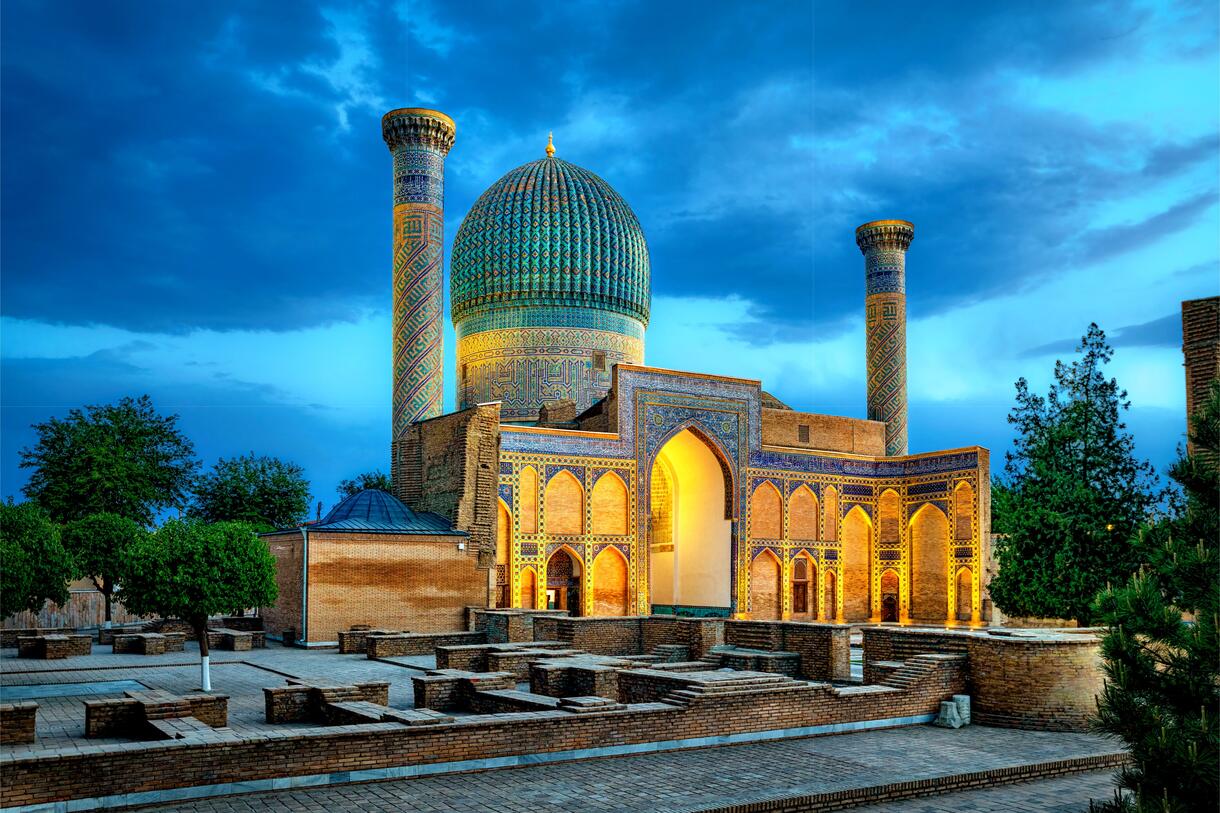
A turquoise dome, a tall portal, dark blue and gold ornamentation — the mausoleum looks stately even from a distance. But behind its architecture lies the story of the Timurid dynasty, of Amir Timur, and of his children and grandchildren.
And although today most tourists come here primarily for the mausoleum of Timur, the story of Gur-e-Amir began with an entirely different person.
What Gur-e-Amir means
The name Gur-e-Amir comes from Tajik/Persian and is usually translated as "tomb of the emir" or "grave of the emir."
The mausoleum was not originally planned as the resting place of Amir Timur himself.
At the start of the 15th century, Timur ordered a mausoleum built for his beloved grandson Muhammad Sultan, who died in 1403. An architectural complex with a madrasah and a khanaka already existed nearby. Later, the fate of this building changed completely.
In 1405, Amir Timur died during a campaign against China. His body was brought to Samarkand and buried right here.
That's how a small mausoleum turned into the main burial site of the Timurid dynasty. Under Ulugbek, Timur's grandson, the complex was expanded and finally transformed into a family mausoleum.
Who is buried in Gur-e-Amir
Looking at the stone gravestones inside the mausoleum, you can see the names of members of Timur's family.
The burials here include:
Amir Timur — founder of the Timurid Empire;
Muhammad Sultan — Timur's grandson, for whom the mausoleum was originally built;
Miran Shah and Shah Rukh — sons of Timur;
Mirzo Ulugbek — his famous grandson, ruler and astronomer;
Mir Sayyid Baraka — Timur's spiritual mentor.
So Gur-e-Amir isn't simply "the tomb of Tamerlane." It's the mausoleum of an entire dynasty that played a huge role in the history of Central Asia.
Why Gur-e-Amir matters so much to the history of Samarkand
In the 14th–15th centuries, Samarkand experienced one of the greatest periods of its flourishing.
Under Timur, the city became the capital of a vast empire and turned into a political, cultural and architectural center of the region. Under his descendants, the development of science, education and art continued.
Many of Samarkand's most famous monuments date to this period: Gur-e-Amir, Bibi-Khanym, Registan, Shah-i-Zinda and the Ulugbek Observatory. UNESCO specifically highlights the Timurid period as the time of greatest development for historic Samarkand.
So a visit to Gur-e-Amir helps you understand why Samarkand looks the way it does.
It's one of the key points where the story of Timurid architecture begins.
The turquoise dome of Gur-e-Amir
The first thing that catches the eye is the enormous ribbed dome.
It's covered in glazed tiles and decorated with an intricate geometric pattern. The mausoleum's entire architecture rests on a combination of strict symmetry, tall proportions and a rich blue-turquoise palette.
Gur-e-Amir looks especially beautiful in evening light, when the surface of the dome begins to shift in tone.
UNESCO counts the Gur-e-Amir ensemble among the most important monuments of historic Samarkand and regards the city's Timurid-era architecture as an outstanding example of Islamic architectural art.
What to see inside the mausoleum
From the outside, Gur-e-Amir impresses with its scale, but it's well worth stepping inside.
The main space of the mausoleum is adorned with marble, mosaic, carving and an abundance of gilding.
Pay special attention to the walls and the dome. Here you'll find extremely intricate geometric and floral ornaments, calligraphic inscriptions and decorative elements.
But the most famous spot is in the center of the hall.
It's a group of stone gravestones, among which the famous jade tombstone of Amir Timur stands out. Timur's actual body doesn't lie directly beneath this stone: a separate crypt is located under the floor of the mausoleum.
That's precisely why the jade tombstone has become one of the symbols of Gur-e-Amir.
Timur's jade tombstone
One of the mausoleum's most unusual objects is a large stone of dark green jade.
It stands among the Timurid gravestones and is linked to the burial of Amir Timur. Today this stone is regarded as one of the mausoleum's main symbols.
The story of how it came to be in Gur-e-Amir is also quite interesting: the tombstone is connected to an earlier chapter of the dynasty's history and to changes that occurred at the burial site after Timur's death.
There's one interesting detail for visitors here: what you see in the main hall isn't the actual graves. The real burials lie in the crypt beneath.
Who was Amir Timur
To understand the significance of Gur-e-Amir, it helps to know at least a little about the man buried here.
Amir Timur, known in Western historiography as Tamerlane, was a ruler of Central Asia in the 14th–15th centuries. His state stretched across vast territories, and Samarkand became its capital.
He is remembered above all as a military and statesman, but his legacy is also tied to large-scale construction.
Under Timur and his descendants, monumental architectural structures rose in Samarkand that still define the city's image today.
That's why Gur-e-Amir should be understood as more than just the burial site of one ruler. It's part of a much larger project to turn Samarkand into an imperial capital.
Ulugbek and Gur-e-Amir
The history of Gur-e-Amir is especially closely tied to Mirzo Ulugbek.
Timur's grandson was an unusual ruler for his time: he is remembered in history above all as an astronomer and scholar.
It was under Ulugbek that Samarkand became one of the most important scientific centers of the East. Scholars worked here, mathematics and astronomy flourished, and the famous observatory was built.
After Ulugbek's death in 1449, he too was buried in Gur-e-Amir, next to his grandfather.
What results is an unusual story: in a single mausoleum lie one of the most famous conquerors of his time and one of the outstanding scholars of the medieval East.
Gur-e-Amir's most famous story: the opening of Timur's tomb
Perhaps no story about Gur-e-Amir attracts as much interest as the events of 1941.
In June 1941, a special scientific expedition opened the Timurid burials. The research was led by historian Tashmuhammad Kary-Niyazov, and the renowned anthropologist Mikhail Gerasimov took part in the work. Scientists examined the remains of Timur, Ulugbek and other members of the dynasty, in part to create anthropological reconstructions.
The work began just days before Germany's invasion of the USSR.
And this is where one of Samarkand's most famous legends arose.
According to a popular version, an inscription on Timur's grave warned that whoever disturbed his remains would bring disaster upon themselves. Soon after the tomb was opened, the Great Patriotic War began, and over time the two events came to be linked together.
But there is no historical evidence that the war began because the grave was opened. The Academy of Sciences of Uzbekistan has specifically pointed out that such claims are unfounded. After the scientific study, the remains were reburied by the end of 1942.
Nevertheless, the story became part of the modern legend of Gur-e-Amir.
And today it's hard to find a tour of the mausoleum that doesn't mention the famous "cursed tomb of Tamerlane."
Why Gur-e-Amir is considered one of the symbols of Samarkand
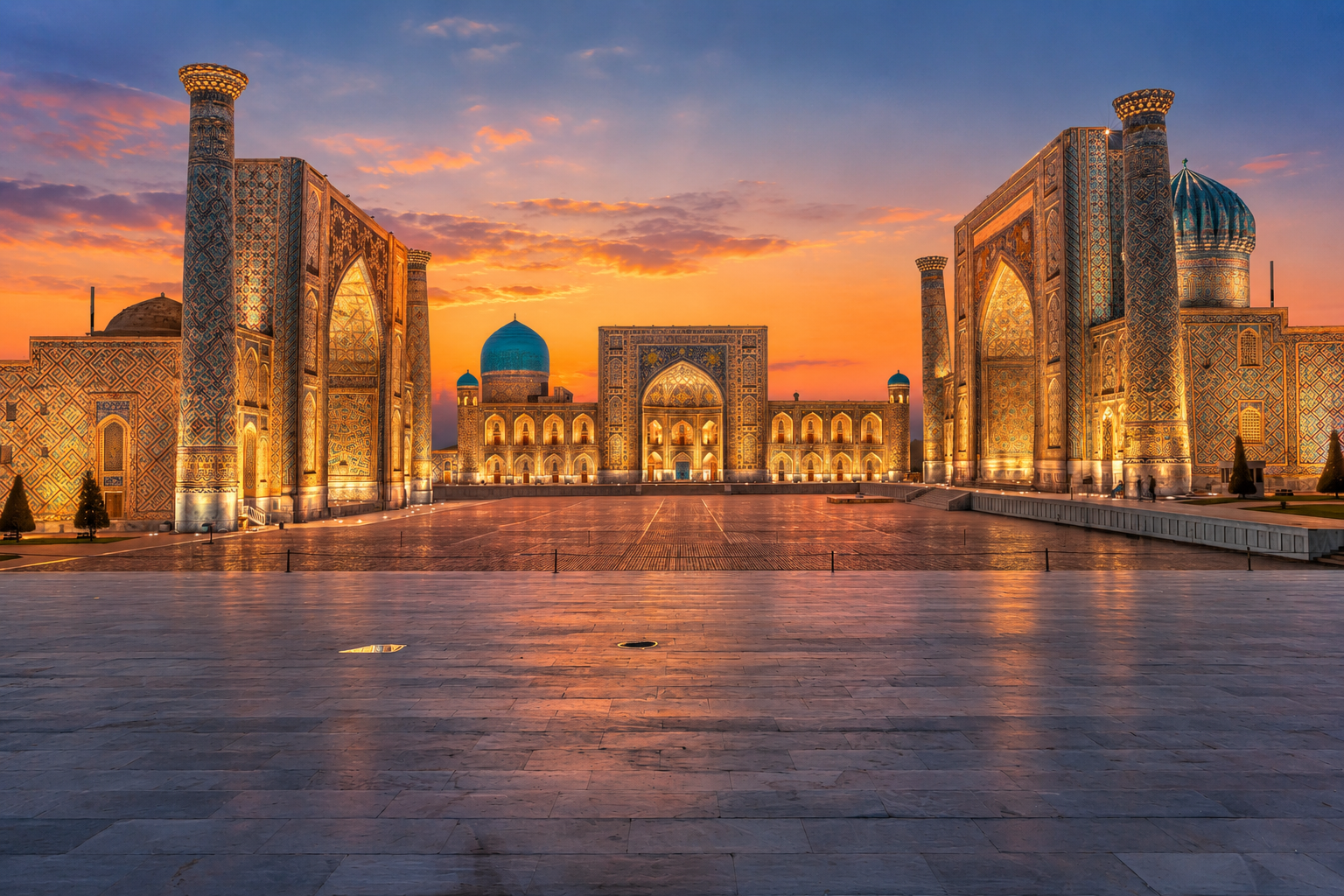
Samarkand has Registan — a symbol of the city's architectural splendor.
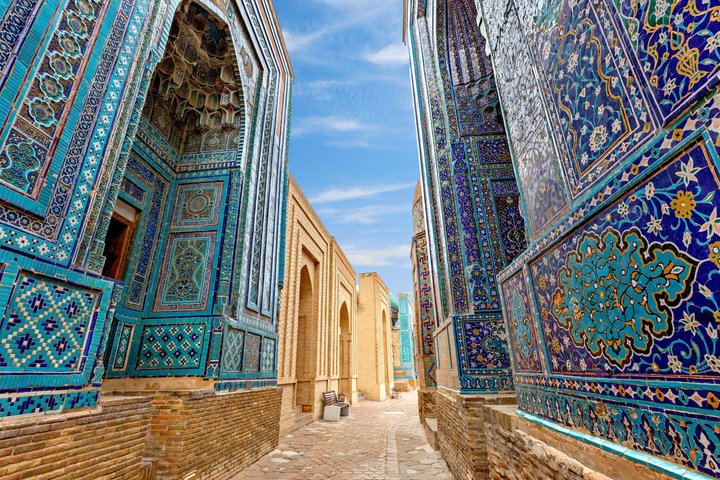
It has Shah-i-Zinda — a place where history is felt through a multitude of mausoleums.
It has Bibi-Khanym — a monument to the scale and ambition of the Timurid era.
And Gur-e-Amir brings all of this together in one story.
Here, Timur and Ulugbek meet, along with military history and science, politics and architecture, legend and real archaeological research.
And it's here, in particular, that it becomes easy to feel just how closely Samarkand's main monuments are connected to one another.
🎧 Want to learn more about Gur-e-Amir during your walk?
You can spend ten minutes at Gur-e-Amir, take a few photos, and move on.
Or you can stop and find out why the mausoleum wasn't originally built for Timur, who is actually buried beneath each of the gravestones, why Ulugbek changed the complex, and how the story of "Timur's curse" came about.
On our Samarkand tour, we tell you all of this right on the spot — where the monuments themselves become part of the story.
You'll walk through the city with a local guide, hear the stories along the route, and gradually see how Gur-e-Amir, Registan, Bibi-Khanym, Shah-i-Zinda and Samarkand's other landmarks connect with one another.
Don't just look at Samarkand — learn the stories behind its monuments.
What to see near Gur-e-Amir
Gur-e-Amir fits well into a longer walk through the historic center of Samarkand.
After the mausoleum, you can head to:
Registan — the city's main square and the famous ensemble of three madrasahs.
Rukhabad — a small but very interesting mausoleum right next to Gur-e-Amir.
Bibi-Khanym — one of the most famous mosques of the Timurid era.
The Siab Bazaar — a great place, after a historic walk, to try Samarkand flatbread, dried fruits and other local products.
If time is short, Gur-e-Amir and Registan are especially easy to combine into a single walk.
Interesting facts about Gur-e-Amir
The mausoleum was originally meant not for Timur, but for his grandson Muhammad Sultan. It was for him that construction began in 1403.
Gur-e-Amir became the Timurid family mausoleum after Timur's death. Ulugbek and other members of the dynasty were later buried here as well.
The actual burials lie in an underground crypt. The stone gravestones in the main hall are memorial markers.
Gur-e-Amir is connected to the history of world architecture. Timurid-era Samarkand had a significant influence on the development of architecture and art in other regions.
Timur's tomb was opened in 1941. After the scientific study, the remains were returned to the mausoleum and reburied.