Registan in Samarkand: History, the Three Madrasahs and What to See
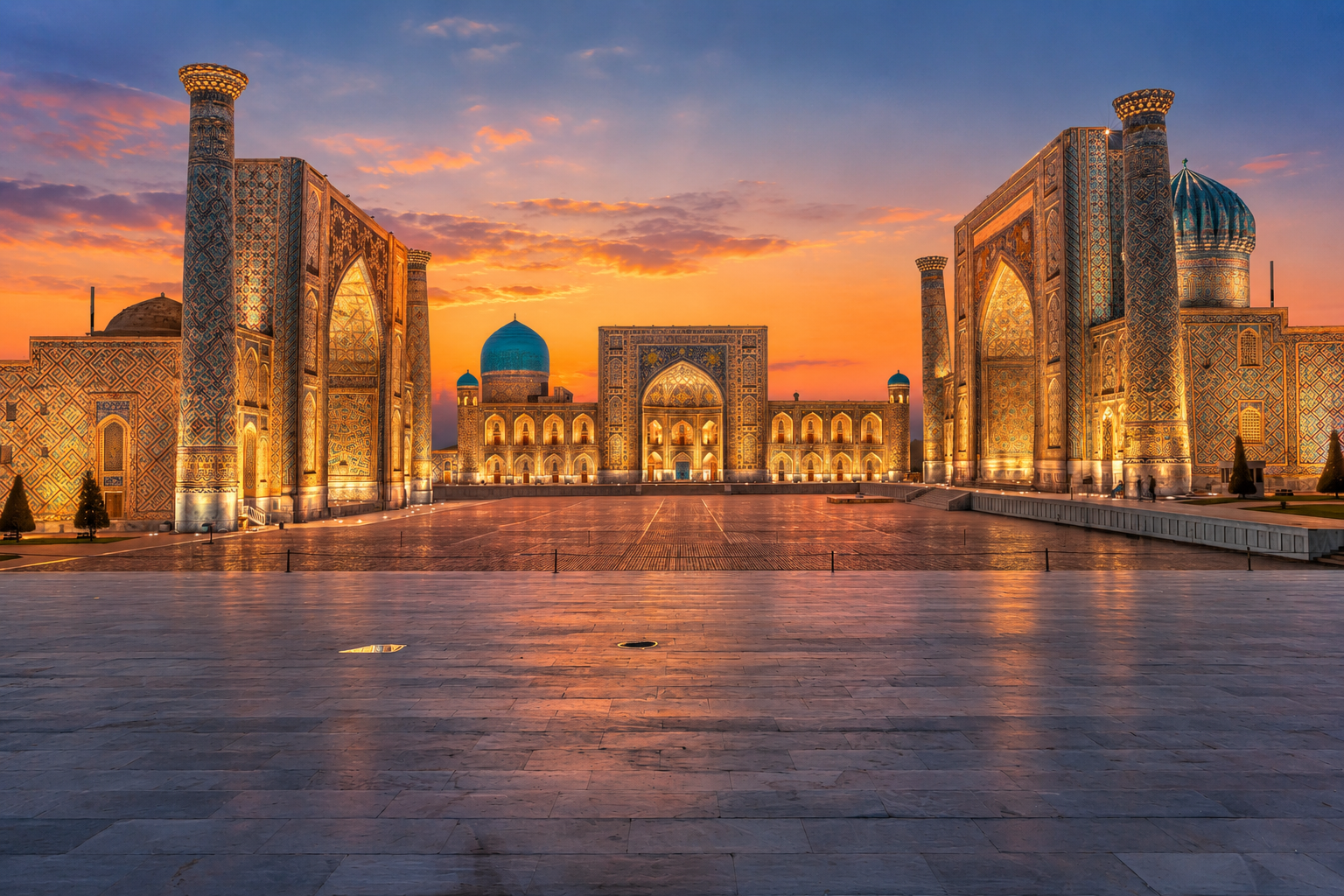
Registan is the most iconic place in Samarkand, and one of those landmarks that looks completely different in person than it does in photos.
A vast square, three monumental madrasahs, blue domes, intricate mosaics and endless ornamentation make Registan a symbol of Samarkand. It's no accident that the historic city of Samarkand, including the Registan ensemble, was added to the UNESCO World Heritage List in 2001.
But behind the beautiful façade lies a history spanning several centuries. Registan was never just a place for photographs — it's where trade, education, politics and the everyday life of Samarkand all intersected.
What the word "Registan" means
The name "Registan" is usually translated from Persian as "sandy place" or "sandy square."
In the medieval cities of Movarounnahr, this was the name given to central squares that became administrative, commercial and craft hubs. Samarkand's Registan gradually turned into exactly this kind of place. Under Amir Timur it served as an important trading center, and under his grandson Ulugbek the square took on a more ceremonial and official role.
In other words, Registan existed long before it took on its current appearance.
Why Registan looks the way it does
Today the square is framed by three enormous buildings:
- Ulugbek Madrasah;
- Sherdor Madrasah;
- Tillya-Kori Madrasah.
But they were built at different times.
The first to appear was the Ulugbek Madrasah, built in 1417–1420. More than two centuries later, in the 17th century, Sherdor and Tillya-Kori were added. So today's Registan isn't the result of a single construction project — it's an architectural ensemble shaped over the course of several centuries.
The Ulugbek Madrasah: Registan in the era of the scholar-ruler
The first building of the ensemble is the Ulugbek Madrasah.
It was built under Mirzo Ulugbek, grandson of Amir Timur, who went down in history not only as a ruler but also as an outstanding astronomer and scholar. The madrasah became one of the largest centers of learning of its time.
And this is where things get really interesting.
Looking at Registan today, it's easy to picture it purely as an architectural monument. But when the Ulugbek Madrasah was built, it was a genuine place of learning.
The building originally had around 50 hujras — small rooms for students. Sources also note that Ulugbek himself taught here, and that the renowned Persian poet Jami lived and worked within the madrasah's walls.
So Registan isn't only a story of rulers and wars. It's also a story of science and education.
And this is one of the reasons why the figure of Ulugbek is so important for understanding Samarkand.
The Sherdor Madrasah: lions, the sun, and an unusual façade
Opposite the Ulugbek Madrasah stands Sherdor, built in 1619–1636 by order of Yalangtush Bahadur. The madrasah was erected on the site of an earlier khanaka built by Ulugbek.
The name "Sherdor" is translated as "home of the lions."
It's the façade that makes this building one of the most recognizable on Registan. The portal depicts a fantastical animal resembling a tiger or a snow leopard chasing a white gazelle. Above the scene is an image of a rising sun.
For tourists, this is one of the details that's easy to miss if you just snap a photo of the square.
Take a close look at the Sherdor portal. It's one of the finest examples of how Registan's architecture turns into a genuine visual narrative.
There's something else worth noting: Sherdor was designed as a kind of mirror image of the Ulugbek Madrasah standing opposite it. Because the ground level of the square shifted over time, the buildings don't look exactly the same height today.
Tillya-Kori: the most lavish interior on Registan
The third side of the square is occupied by the Tillya-Kori Madrasah.
Construction began in the 1640s and was completed around 1660. Unlike the other two buildings, Tillya-Kori wasn't purely educational — it also housed a large mosque inside.
The name translates as "gilded" or "covered in gold."
And this is the place you absolutely have to step inside.
The mosque's main hall is decorated with elaborate painting and gold. It's often the interior of Tillya-Kori that becomes the biggest surprise for visitors: from the outside, it seems like the most impressive part is already in front of you, but inside there's an even more striking space waiting.
The gilded decoration is so lavish that the name "Tillya-Kori" truly feels well earned.
Why Registan is called the heart of Samarkand
Samarkand is more than two thousand years old, but it was the Timurid era that made the city one of the most important cultural and political centers of Central Asia.
UNESCO notes that historic Samarkand developed especially intensively in the 14th–15th centuries, when it was the capital of the Timurid state. The city's architecture had a significant influence on the development of Islamic art and architecture across many regions of the East.
Registan ended up at the very center of this historical space.
Here you can literally see how Samarkand changed: from a center of learning in Ulugbek's era to a sweeping 17th-century architectural ensemble.
That's exactly why the three buildings sit together so harmoniously, even though nearly 200 years passed between their construction.
Interesting facts about Registan
Registan isn't the name of a single building
When people say "I've been to Registan," they mean the square and the whole ensemble, not one particular madrasah.
The three madrasahs were built at different times
Ulugbek dates to the early 15th century, while Sherdor and Tillya-Kori are from the 17th century. So the square's modern appearance took shape gradually.
Ulugbek was more than just a ruler
He became famous as an astronomer and scholar. His name is tied not only to Registan, but also to the famous observatory in Samarkand.
Sherdor features an image of an animal and the sun
This unusual scene became one of the most recognizable details on all of Registan.
Registan is part of the UNESCO World Heritage List
Historic Samarkand was added to the list in 2001, based on several criteria related to the city's architecture, urban planning and historical significance.
The best time to visit Registan
The square looks completely different by day than it does in the evening.
In bright sunlight, the colors of the ceramic mosaics and the fine details of the façades are especially vivid. In the evening the space becomes more atmospheric, and Samarkand also hosts special light and multimedia programs. Uzbekistan's tourist programs, for instance, often include a separate visit to the 3D show on Registan Square.
So if time allows, it's worth seeing the square twice — during the day and after dark.
Each visit leaves a completely different impression.
What you absolutely must see at Registan
If this is your first visit, don't limit yourself to a photo from the center of the square.
Pay attention to:
The Ulugbek Madrasah — the portal, the minarets, and the story of Ulugbek himself.
The Sherdor Madrasah — the famous image of the animals and the sun above the entrance.
Tillya-Kori — make sure to go inside and see the gilded interior of the mosque.
The madrasahs' inner courtyards — this is the best place to really feel the scale of the buildings.
The mosaics and calligraphy — the longer you look, the more details you notice.
And most importantly — don't rush.
Registan is made for looking up, getting close to the details, and noticing something new every time.
🎧 Want to know more about Registan than what's written on the plaques?
Registan holds dozens of stories that are easy to miss on a self-guided walk.
Why did Ulugbek choose to build his madrasah right here?
Who was taught here in medieval Samarkand, and what did they study?
Why do a predator, a gazelle and the sun appear on Sherdor?
What do the patterns and inscriptions on the walls mean?
And why is Tillya-Kori called "gilded"?
You can learn all of this in detail on our Samarkand tour.
You'll walk through the city with a local guide, hear the stories right there at the landmarks, and see Samarkand not just as a beautiful backdrop, but as a city with a thousand-year history.
Registan is only the beginning
Samarkand is much more than a single square.
After Registan, it's worth continuing to explore the city: Gur-Emir, Bibi-Khanym, Shah-i-Zinda, the Siab Bazaar and the Ulugbek Observatory. Together, these sites help explain why UNESCO calls historic Samarkand a crossroads of world cultures.
You can also visit and explore the out-of-town monuments around Samarkand as part of our tour Samarkand and its surroundings.