Shah-i-Zinda in Samarkand: History, Mausoleums and the Legend of the "Living King"
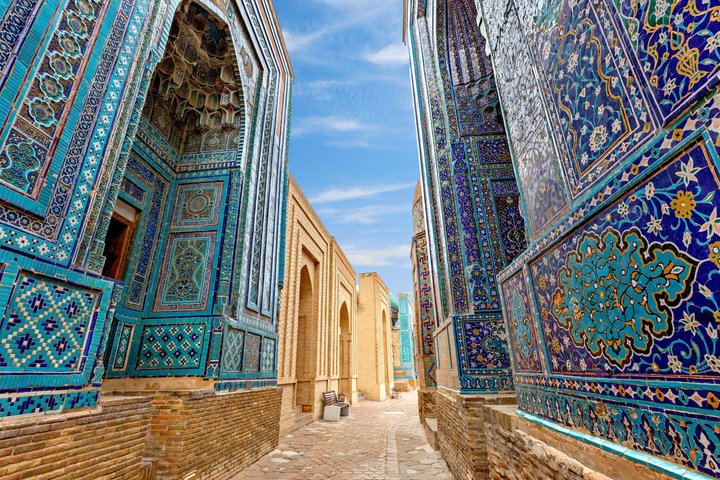
A narrow passage gradually climbs past dozens of blue and turquoise mosaics. Mausoleums appear on either side, decorated with the most intricate ceramics, ornamentation and calligraphy. It feels less like a single architectural ensemble and more like an entire city frozen in time.
Shah-i-Zinda is considered one of the main monuments of historic Samarkand and is part of the UNESCO World Heritage site "Samarkand — Crossroad of Cultures."
But the story of this place begins long before the era of Amir Timur.
And it's exactly here that our walking tour of Samarkand's main landmarks begins.
What "Shah-i-Zinda" means
The name "Shah-i-Zinda" comes from Persian and translates as "the Living King."
The name is linked to Qusam ibn Abbas, whom tradition considers a cousin of the Prophet Muhammad. According to historical and religious tradition, Qusam ibn Abbas came to Samarkand in the 7th century along with the Arabs and worked to spread Islam.
His name is also tied to Shah-i-Zinda's main legend.
According to the story, Qusam ibn Abbas was attacked while praying. One version says he hid in the mihrab; another says he descended, carrying his own severed head, into a deep well leading to an underground garden, where he continues to live to this day.
That's exactly where the name comes from — "the Living King."
This is, of course, a legendary tradition rather than an established historical fact. But it's precisely this legend that shaped the spiritual significance of this place for centuries.
How the necropolis came to be
Shah-i-Zinda is located on the southeastern slope of ancient Afrasiab — the site of old Samarkand.
Until the second half of the 11th century, this was a residential part of the city. Later, this outlying area gradually began turning into a necropolis. One of the first significant structures was the tomb of Qusam ibn Abbas, and other mausoleums began appearing around it.
In other words, Shah-i-Zinda isn't a monument to a single ruler, or even an ensemble built over just a few years.
This place took shape over centuries.
That's exactly why you can see the architecture of several eras here at once.
What happened to Shah-i-Zinda after the Mongol invasion
In the 13th century, much of Samarkand's construction was destroyed during the Mongol conquest. Shah-i-Zinda also suffered serious damage.
But the shrine of Qusam ibn Abbas continued to exist, and in the 14th century new construction began. New mausoleums appeared, and architects gradually shifted from carved terracotta to glazed ceramic cladding. It was then that the ensemble began to take on the blue, light-blue and turquoise colors that Shah-i-Zinda is associated with today.
The ensemble developed most actively during the era of Amir Timur.
His relatives and members of the nobility built mausoleums here next to the revered tomb of Qusam ibn Abbas. As a result, the necropolis turned into an entire gallery of architectural monuments from the Timurid era.
Shah-i-Zinda and the family of Amir Timur
If you look closely at the mausoleums, it becomes clear that many of them are connected to members of Samarkand's ruling elite.
Here lie the tombs of Timur's relatives and members of the nobility, and some structures hold particular importance for the history of Timurid architecture.
One of the best-known examples is the mausoleum of Shadi-Mulk-Aka, built in 1372 for a niece of Amir Timur. It's called one of the architectural gems of Shah-i-Zinda.
Its façade is especially interesting for its combination of carved terracotta, majolica and intricate ornamentation.
And this is one of the features of the entire complex: here you can literally trace how craftsmen experimented with color, form and ways of decorating buildings.
The most beautiful thing at Shah-i-Zinda is the ceramics
Many people come here for the photographs, and Shah-i-Zinda is indeed considered one of the most striking places in Samarkand.
But photographs don't always convey the most important part.
Look at the walls up close.
The ornaments use geometric shapes, floral motifs, Arabic calligraphy and extremely intricate compositions made of glazed ceramics.
Different mausoleums show completely different ways of working with the material.
That's exactly why it's interesting to look at Shah-i-Zinda not as one big monument, but as a collection of works by architects, ceramicists and calligraphers from different eras.
The mausoleum of Tuman-Aka
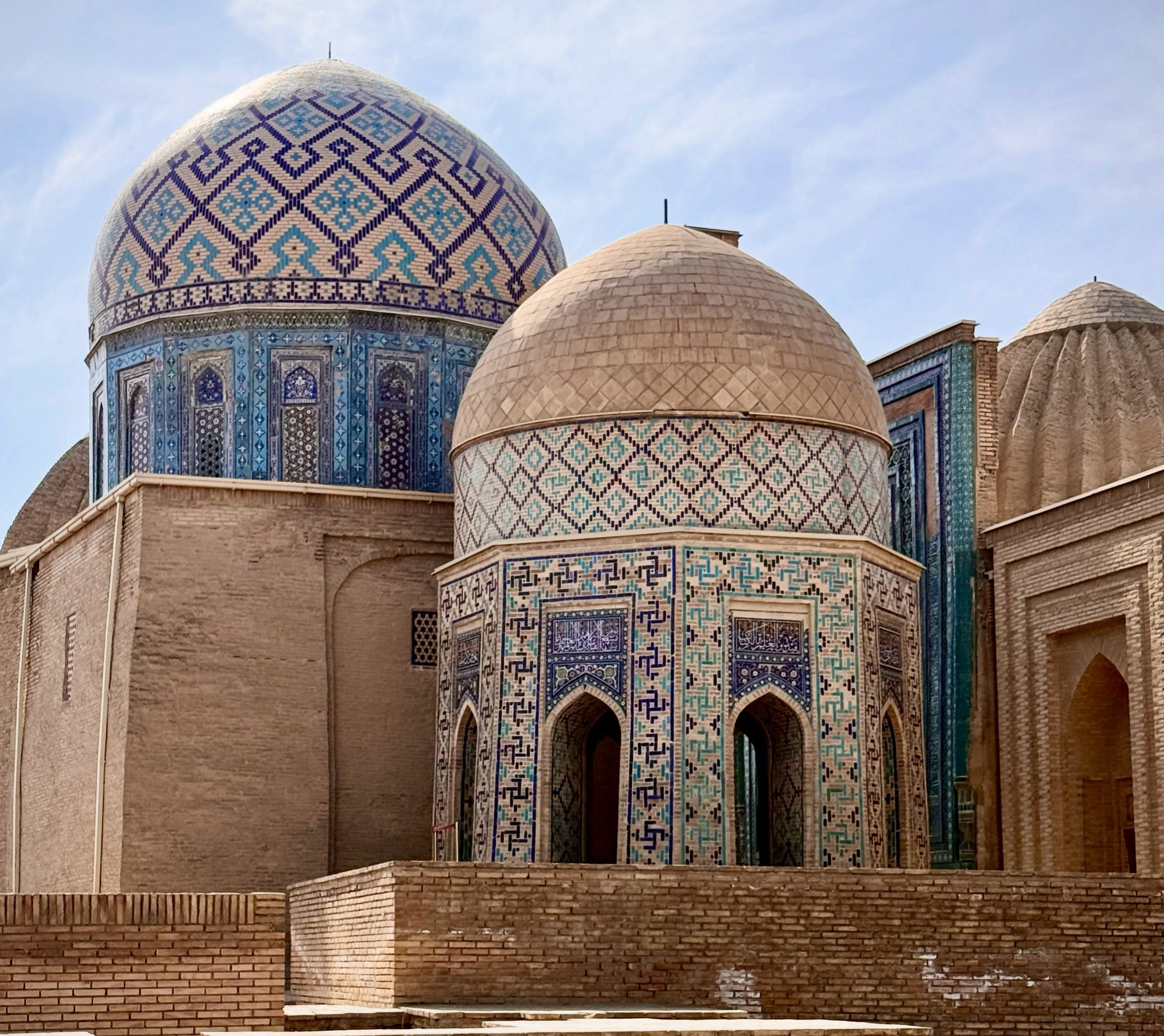
One of the ensemble's most recognizable monuments is the mausoleum of Tuman-Aka, built at the end of the 14th and beginning of the 15th century.
Tuman-Aka was a wife of Amir Timur. The complex differs from earlier mausoleums through its rich color palette and intricate mosaic work. Blue, light blue, white, black, yellow and purple were all used here.
The contrast between the exterior and interior decoration is especially interesting.
Outside, a vivid mosaic portal catches the eye, while inside the character of the space changes: the ornaments become more intimate, and the domed section resembles a decorative representation of the sky.
The mausoleum of Qusam ibn Abbas
At the far end of the ensemble is the site that matters most from a religious standpoint — the complex of Qusam ibn Abbas.
This is Shah-i-Zinda's most ancient core.
The complex itself was rebuilt many times, and during the era of Amir Timur it was significantly renovated and expanded. Its famous wooden door dates to 1404–1405 and is considered an outstanding example of wood carving.
Here you'll find the ziyaratkhana — a room for worship, the gurkhana — the burial chamber, and other rooms of the complex.
It's precisely here that you can especially feel how Shah-i-Zinda differs from an ordinary architectural monument.
This isn't only a museum or simply a historic building. For many visitors, the complex remains a sacred place.
Why Shah-i-Zinda looks like a street of mausoleums
One of the complex's most interesting features is its layout.
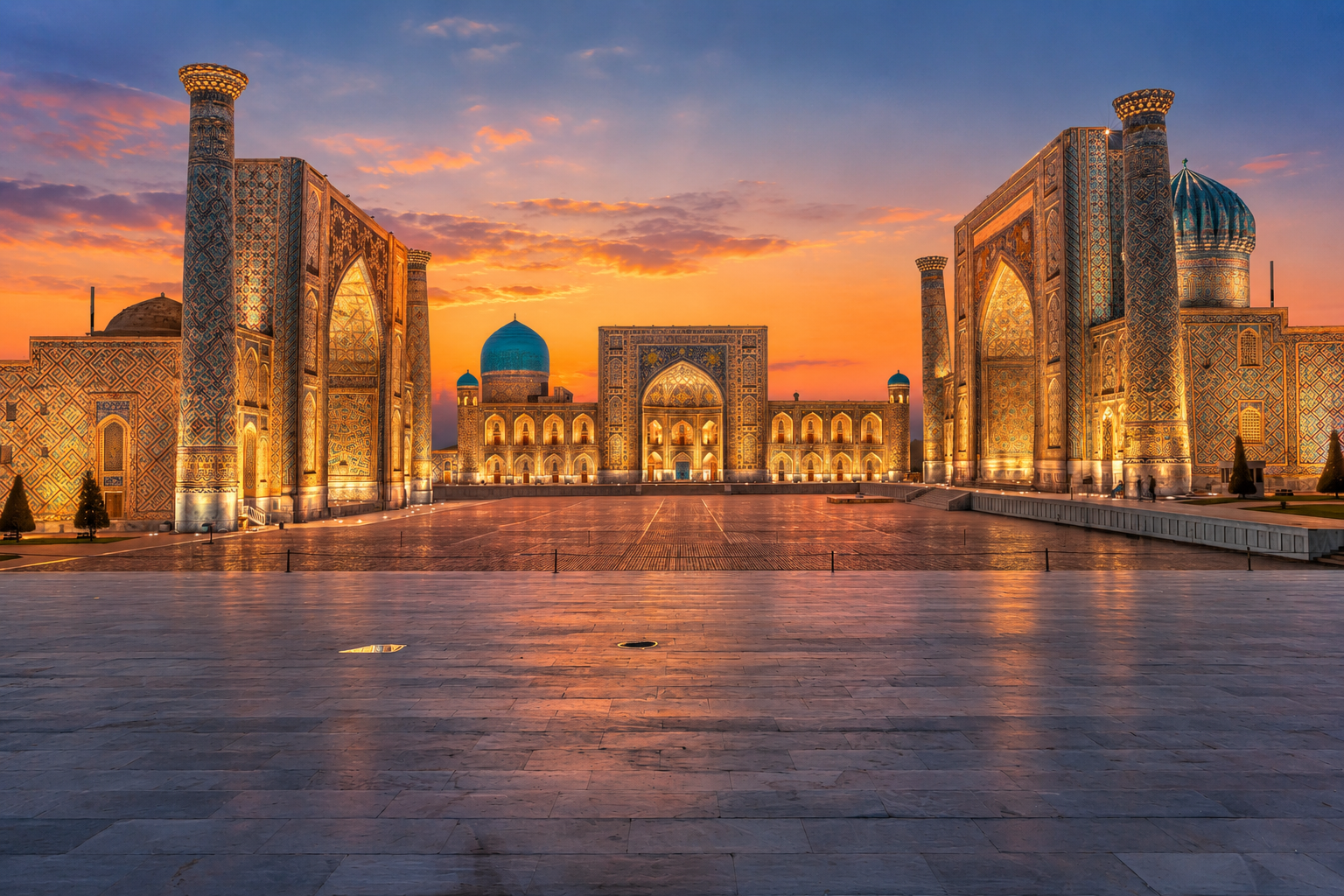
You're not standing in front of one enormous building, as at Registan.
Instead, before you appears a narrow passage lined with mausoleums on both sides, gradually leading upward.
This composition took shape gradually, so different buildings are literally joined to one another.
Today, Uzbekistan's official tourism resource states that the complex includes 11 mausoleums, most of them dating to the 14th century. Alongside them, there are mosques and other ritual structures from various periods.
Shah-i-Zinda and Ulugbek
The name Mirzo Ulugbek is tied to another important chapter in the complex's history.
During his reign, major architectural and planning work was carried out here, and the lower entrance group was created.
This period is also linked to the twin-domed mausoleum traditionally associated with Qazizadeh ar-Rumi — the famous astronomer and scholar who worked in Samarkand under Ulugbek.
So Shah-i-Zinda once again turns out to be connected to one of the central themes of Samarkand's history — the development of science and culture during the Timurid era.
The Shah-i-Zinda staircase
Before entering the main ensemble, visitors must climb a long staircase.
A tradition often mentioned during a visit to the complex is tied to this staircase as well: some pilgrims treat the climb as a special part of the journey and try to count the steps.
You can find different versions online about the exact number of steps and related rules. So such stories shouldn't be taken as an established historical tradition.
But the staircase itself matters even without the legends: it gradually pulls the visitor away from an ordinary city street and literally leads them inward, into the necropolis.
Why Shah-i-Zinda has stayed so alive in Samarkand's memory
Samarkand has lived through many political and cultural changes.
States rose and fell here, buildings were destroyed and rebuilt, and the very urban landscape kept changing.
But Shah-i-Zinda continued to remain an important spiritual place.
Today the complex is regarded by UNESCO as one of the key monuments of historic Samarkand. The city itself is on the World Heritage List as an outstanding example of the development of art, architecture and urban culture in Central Asia.
🎧 Want to get to know Shah-i-Zinda beyond the pretty photos?
It's easy to spend half an hour at Shah-i-Zinda photographing the blue domes and mosaic walls.
But it's far more interesting to understand who is buried in each of the mausoleums, why a necropolis arose here of all places, where the name "the Living King" came from, and how the architecture evolved from the earliest structures to the Timurid era.
On our Samarkand tour, we tell you all of this right on the spot — at the mausoleums themselves, where the history becomes far easier to grasp.
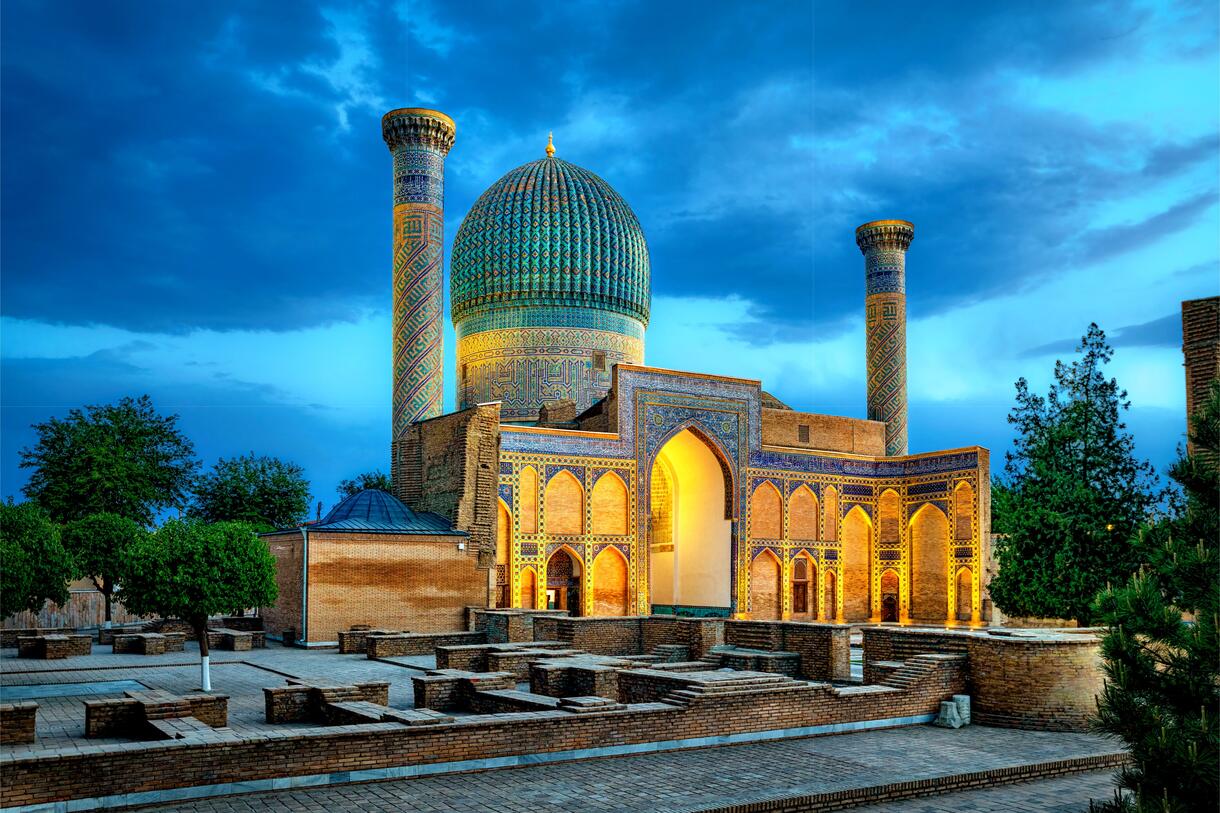
You walk with a local guide, hear the stories along the route, and connect Shah-i-Zinda with the city's other important sites — Registan, Gur-e-Amir, Bibi-Khanym and the Ulugbek Observatory.
Samarkand reveals itself much better once every mosaic starts to have its own story.
What to see near Shah-i-Zinda
Shah-i-Zinda is located right next to ancient Afrasiab, so it's easy to devote this part of Samarkand to the city's history across several eras at once.
After visiting the necropolis, you can head to:
Afrasiab and the Afrasiab Museum — to see the oldest Samarkand of all.
The Ulugbek Observatory — one of the most important monuments in the city's scientific history.
The Bibi-Khanym Mosque — a grand monument of the Amir Timur era.
And then continue your walk to the Siab Bazaar and on toward Registan.
Interesting facts about Shah-i-Zinda
The name means "the Living King." It's tied to the legend of Qusam ibn Abbas.
The complex took shape over centuries. The first significant structures appeared here as early as the 11th century, while the most intensive construction took place in the 14th–15th centuries.
The complex includes 11 mausoleums. Most of the surviving structures date to the 14th century.
Shah-i-Zinda is part of a UNESCO World Heritage site. Historic Samarkand was added to the list in 2001.
Monuments of several different artistic traditions have survived here. You can see early terracotta, glazed tiles, mosaic, calligraphy and wood carving.