Can you visit Uzbekistan in summer?
First, about Chilla
Uzbekistan has its own folk name for the hottest period of summer — Chilla, from the Persian word for "forty." It begins in the third week of July and lasts 40 days. This is the peak of the summer heat, when temperatures stay above +38…+40°C.
But in recent years, the weather hasn't been playing by the rules. In early July it can be +25°C with rain, as it was this year. And in midsummer, rain and even hail have been known to occur — something that was almost unheard of before. The reasons are worth a long discussion: El Niño, climate shifts, or simply an anomalous year. The point is this — the season has become less predictable, and planning a trip strictly "by the calendar" no longer works. But that's no reason to write off summer.
Why +40°C in Uzbekistan is easier than +30°C in Moscow
Here's the key thing most people miss. When comparing heat in different cities, people look only at the temperature and get scared. But without humidity, that's only half the picture.
City — Summer humidity
Tashkent 30–40%
Moscow 60–80%
Saint Petersburg 70–90%
Tropics (Thailand, Singapore) 75–95%
The air in Uzbekistan is very dry, so +30°C here is nothing like +30°C in Moscow with high humidity — that's genuinely exhausting. Many people find +40°C in Tashkent more comfortable than +30°C in Moscow, precisely because of the dry air.
The clearest way to explain it is with a sauna. In a dry sauna at +100°C, the body handles the heat more easily than in a hammam or steam room at +60°C. The same principle applies to cities: dry air lets sweat evaporate instead of clinging to your skin, so the body cools more efficiently.
Dry air does have a downside: it dries out skin, mucous membranes and hair quickly. So during the hot season, it's especially important to drink plenty of water and use moisturiser.
Is it worth visiting Uzbekistan in summer: the upsides of the season
Yes, if you plan your day well. Summer has its advantages:
- Fewer tourists. Monuments and madrasas aren't packed with tour groups — you can take your time with the details and get a photo without strangers in the frame.
- Warm, beautiful evenings — by evening the temperature becomes very comfortable.
- Monuments stay open late: in Tashkent, Samarkand and Bukhara, summer hours are extended so you can stroll after sunset.
- City illumination and musical fountains. The city looks completely different at night.
How to plan your day so the heat doesn't get in the way
The formula is simple:
- Early morning — head out early and try to be back indoors by 11:00. The best time for walking around the city.
- 11:00 to 17:00 — indoors. Spend the hottest part of the day with air conditioning: museums, pools, exhibitions.
- By 18:00 — back outside. You still have about three hours of beautiful golden light, the best time for photography.
- Evening and night — the most pleasant part of the day: comfortable temperatures, illuminations, fountains, monuments open late.
Tashkent's metro is also a great option during the hottest hours: it's cool inside, and several stations are considered among the most beautiful in the world.
By the way. For those "air-conditioning hours," many people listen to my audio tours — you can listen in a museum, a café, or by the hotel pool, not just while walking. More on that at the end of the article.
Practical tips for the hot season
- Check the UV index in your weather app. If it's above 3, protect yourself: sunscreen, a wide-brimmed hat, a long-sleeved shirt.
- Clothing — loose, light-coloured, cotton or linen. Synthetics feel worse in dry heat.
- Always carry water. Bottled water in Uzbekistan is inexpensive and sold on almost every corner.
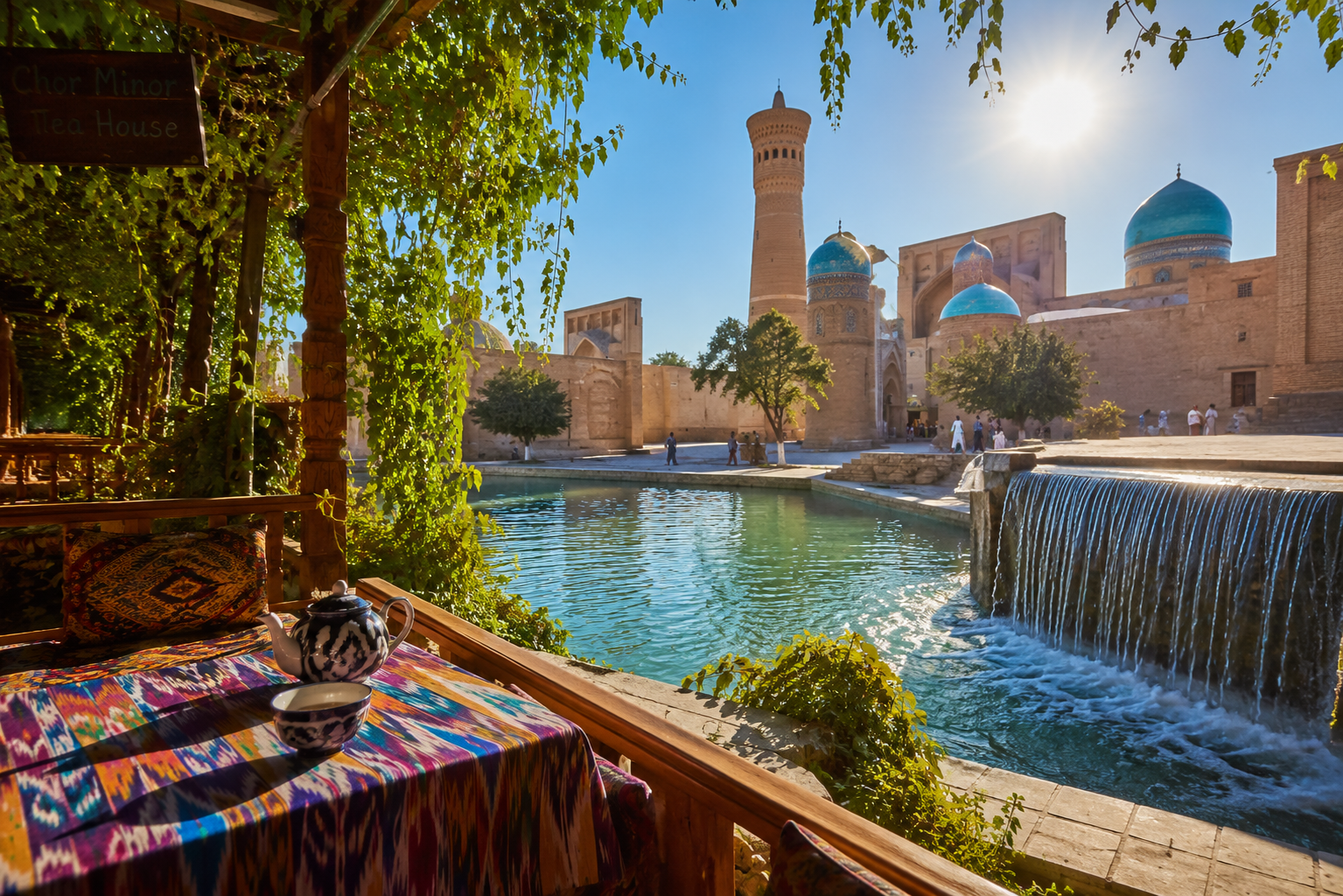
- Hot green tea cools you down better than cold drinks — a local tip worth trying at any teahouse.
- The dress code for mosques and madrasas — covered shoulders and knees — also protects from the sun, so practicality and necessity go hand in hand.
- Seasonal watermelons and melons in July–August are excellent for hydration and are one of the culinary highlights of any trip.
- When ordering a taxi through an app, you can check whether it has air conditioning if you're travelling during the hottest hours.
Escaping the heat: mountains near Tashkent
On the hottest days, many locals (ourselves included) head to the mountains for a day. Near Tashkent, the options are Chimgan, Charvak, Amirsay and Parkent. It's noticeably cooler there than in the city — a great day trip to catch your breath and come back refreshed for evening walks around town.
Frequently asked questions about summer in Uzbekistan
How many days do you need in Uzbekistan in summer? For Tashkent, Samarkand and Bukhara combined, it's comfortable to allow 7–9 days, accounting for travel between cities and the heat-adjusted daily rhythm (part of the day is lost to the midday pause).
What should you pack for the heat? Light cotton or linen clothing, a wide-brimmed hat, sunscreen, a water bottle, and a light scarf for places with strong air conditioning.
Are museums and monuments open in summer? Yes, and in Tashkent, Samarkand and Bukhara many sites extend their hours in summer, so you can visit after sunset.
Is it worth going to Uzbekistan in July–August if I struggle with heat? Yes, if you plan your day: early morning walks, a pause indoors from 11 to 17, then back outside towards evening. Dry air is noticeably easier to handle than humid heat.
My audio guide: a real guide's tour, on your own schedule, at a fraction of the price
If you're planning to explore independently rather than with a group, I've turned my tours of Tashkent, Samarkand and Bukhara into a digital format — City Insider.
This isn't a faceless audio recording of dates and facts — it's my personal narration, the same one I've been delivering live to groups since 2009. The only difference is that instead of a fixed schedule and a group, you decide when and where to go: at noon under air conditioning, or at night by lamplight.
What's inside:
- 3 cities — Tashkent, Samarkand, Bukhara
- 5 languages — Russian, English, French, German, Chinese
- First-person storytelling, not dry facts
- Photos and videos along the route
- Ask the guide a question during your walk
- Practical tips along the way: where to eat, where to change money, where the nearest restroom is
The price per tour is symbolic — a fraction of the cost of a live guide, with the same storytelling, the same route, the same delivery.
You can try it for free: download the app and listen to the free tour of the Museum of Applied Arts — no commitment, so you can hear for yourself what I mean.
Available in the Telegram bot (no download needed) and in the mobile app with offline mode — in case you don't have internet access on the road.