The Alisher Navoi Theatre in Tashkent: History, Architecture and What to See
Some buildings become part of a city's image.
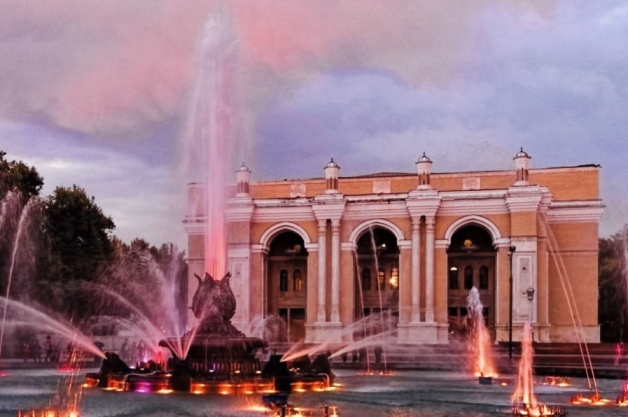
In Tashkent, one such place is the Alisher Navoi State Academic Bolshoi Theatre — the famous opera and ballet theatre right in the center of the capital.
Even if you're not planning to see a performance, it's worth coming here just for the architecture. A monumental façade, arcades, marble, ganch carving, national ornaments and richly decorated interiors make the theatre one of Tashkent's most interesting mid-20th-century buildings.
And the story of its construction is a tale in its own right.
How the Alisher Navoi Theatre came to be
The theatre's history begins even before its famous building appeared.
In 1929, under the direction of Mukhiddin Kari-Yakubov, a professional concert and ethnographic ensemble was formed. Musical and theatrical productions gradually developed, and in 1939 an opera and ballet theatre was officially established.
At the same time, the idea arose of building it a large, modern home.
An open competition was announced for the project, and in 1934 the winner was the well-known Soviet architect Alexey Shchusev. It fell to him to design a building that would meet the needs of a modern theatre while reflecting Uzbekistan's architectural traditions.
Construction began in September 1940 on the site of the former Resurrection Market.
But history had its own plans.
The theatre was built during the war
In 1942, construction had to be halted because of the war. Work resumed in 1943, and in the final stage Japanese prisoners of war, transferred to Tashkent after the fighting ended, were brought in to help build it.
This is one of the best-known chapters in the building's history.
What makes it especially interesting is that the Japanese workers weren't involved merely in raising walls. The theatre's official history recounts that the renowned master craftsman Tashpulat Arslankulov taught Japanese workers traditional Uzbek ganch carving.
So the theatre's story turned out to be an unusual one: Soviet architecture, Uzbek craft traditions, and people from entirely different parts of the world all met in its creation.
The theatre's opening
The new theatre opened with great ceremony on November 6, 1947.
The first production in the new building was the opera "Valley of Happiness" by Mustafa Ashrafi and Sergei Vasilenko.
In 1948, the Uzbek troupe merged with the Sverdlov Russian Opera Theatre, after which the theatre was given the status of the Alisher Navoi State Opera and Ballet Theatre. In 1959 it received academic status, and in 1966 — the status of a Bolshoi Theatre.
That's how the Alisher Navoi State Academic Bolshoi Theatre we know today came to be.
Why the theatre is named after Alisher Navoi
Alisher Navoi was a great poet, thinker and statesman of the 15th century — one of the key figures in the cultural history of Central Asia.
He wrote primarily in the Chagatai language and is considered one of the greatest figures in Turkic literature.
For Uzbekistan, Navoi's name is tied to more than just literature. It's a symbol of the development of language, culture, art and education.
That's why the theatre, intended to become one of the country's leading cultural institutions, was given his name.
Alexey Shchusev and the theatre's unusual architecture
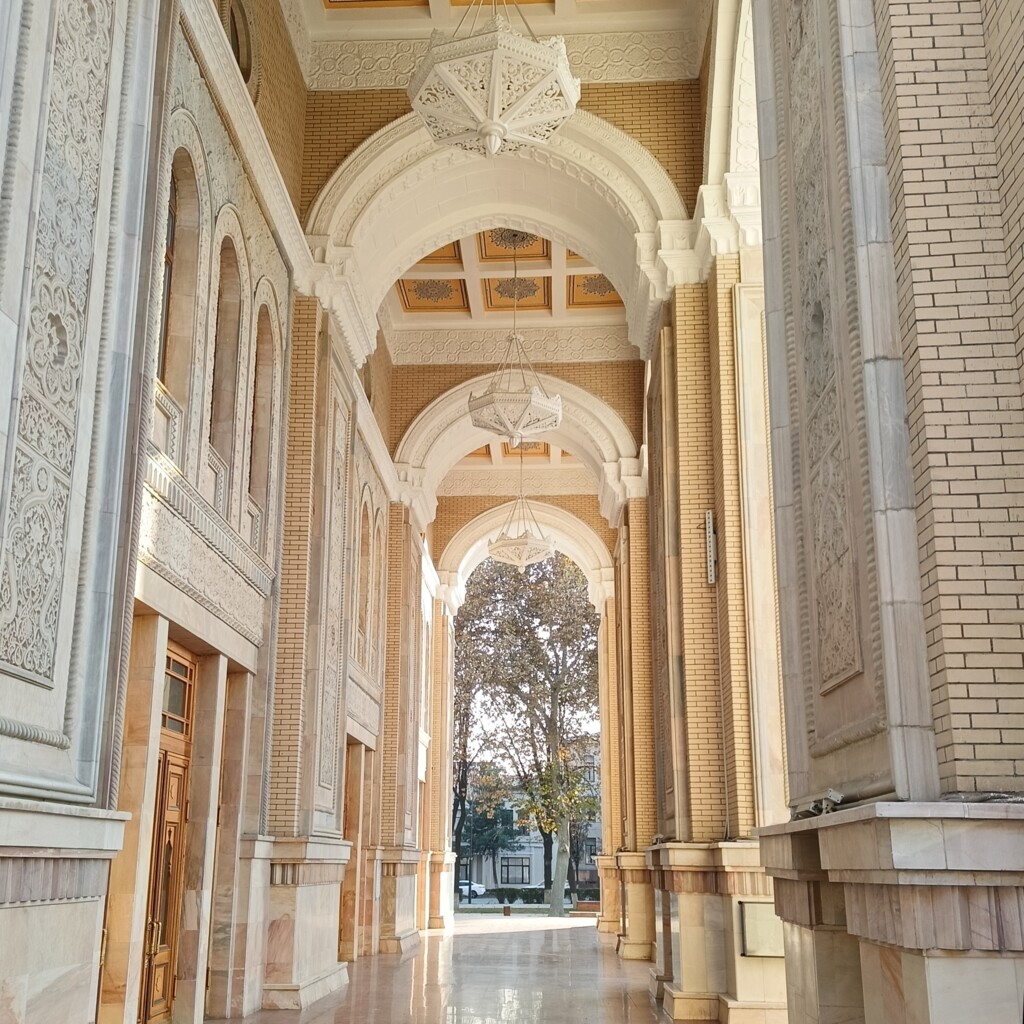
At first glance, it's easy to mistake the theatre for a classic monumental Soviet building.
But look closer, and you'll notice just how strongly Shchusev drew on Uzbekistan's architectural traditions.
The main façade is adorned with a tall three-arch portal, and the sides of the building with arcades. The overall composition looks monumental while also fitting quite harmoniously into the space of the Theatre Square.
Shchusev sought to make the theatre not just a large building for performances, but a true architectural centerpiece of the city.
And that goal was achieved.
Today the theatre remains one of Tashkent's most recognizable buildings.
The most interesting part begins inside
If the exterior façade impresses with its scale, the theatre's interior may surprise you even more.
The main hall seats about 1,500 spectators and includes the stalls, boxes and two tiers. The walls and balconies are decorated with gilded ornaments. Tashkent's official tourism portal specifically notes the hall's excellent acoustics.
But the main adornment is the foyer and side halls.
Here the traditional technique of ganch carving is used — a special gypsum-based material that has been used in Central Asian architecture for centuries.
It's precisely here that the theatre turns from simply a beautiful Soviet building into a space that tells the story of Uzbek decorative art.
Six regions of Uzbekistan under one roof
One of the most interesting features of the interiors is that different spaces are decorated in the traditions of different regions of Uzbekistan.
Master craftsmen representing different schools of applied art — Tashkent, Samarkand, Bukhara, Khiva, Termez and Fergana — took part in creating the decorative finishes.
So a walk through the theatre becomes almost a small journey across Uzbekistan.
It's worth paying attention not only to the overall look of each hall, but to the details:
ganch carving;
floral and geometric ornaments;
murals;
gilding;
the shapes of ceilings and arches.
Many of these details are easy to miss if you only see the theatre from your seat in the auditorium.
A story told by the walls
There's a wonderful idea in the theatre's official history: Shchusev conceived the building as a kind of marble palace, inspired by Eastern architecture and the poetic world of Navoi.
And indeed, it's fascinating to see how Soviet architecture tried to speak the language of local culture here.
This isn't an exact copy of a medieval palace.
Shchusev created a modern building, but deliberately used familiar forms: arches, inner courtyards, decorative carving and national ornaments.
The result is an architectural hybrid very characteristic of Tashkent.
The theatre has survived decades and continues to work
Over the decades, the theatre's stage has hosted operas and ballets from the world classical repertoire as well as works tied to Uzbek culture.
Among the first productions were "Eugene Onegin," "The Queen of Spades," "Swan Lake," "Farhad and Shirin" and "Tahir and Zuhra."
And the theatre continues to operate as exactly that — a working theatre, not just an architectural monument.
Today the State Academic Bolshoi Theatre is considered Uzbekistan's leading institution in the field of opera and ballet. Its repertoire includes world classics, touring productions, concerts and other cultural programs.
Theatre Square
In front of the theatre lies the spacious Theatre Square, long a favorite spot for walks in central Tashkent.
Here stands the famous fountain shaped like a cotton boll. Later, together with the hotel built nearby, it formed the square's recognizable architectural ensemble. Today the fountain operates as a musical light fountain, and in the evening the theatre's façade is illuminated.
So it's worth visiting the theatre not only during the day.
In the evening, the space takes on an entirely different mood.
The building is lit up, the square grows livelier, and the fountain becomes an attraction in its own right.
What changed after the renovation
Between 2010 and 2015, the theatre underwent a major renovation.
The work updated the engineering systems and theatre spaces, and also restored the decorative finishes — including the traditional ganch carving and murals.
The goal, however, wasn't to turn the theatre into a new, modern building, but to preserve its historic appearance.
Today's visitor can see practically the same architectural language that was created in the 1940s.
Interesting facts about the Alisher Navoi Theatre
The theatre's design won an open competition. Its author was the architect Alexey Shchusev.
Construction began in 1940, but was halted by the war and resumed in 1943.
The theatre opened in 1947. The first production in the new building was the opera "Valley of Happiness."
Japanese prisoners of war took part in the construction, and master craftsman Tashpulat Arslankulov taught some of them traditional ganch carving.
The main hall seats about 1,500 spectators.
The interiors showcase the traditions of different regions of Uzbekistan — from Tashkent and Samarkand to Bukhara, Khiva, Termez and Fergana.
Between 2010 and 2015, the theatre underwent a major renovation. The building's historic decorative appearance was preserved.
🎭 Is it worth going to a performance at the theatre?
Absolutely — if you have the chance during your trip to Tashkent.
Attending a performance lets you see the building in a completely different light.
By day, you look at it as an architectural monument.
In the evening, you step inside, climb the staircases, see the foyer, the carved ganch, the gilded details, hear the music, and find yourself inside a space that was created almost a century ago as Tashkent's main theatre.
This is no longer just a sight to see.
It's an encounter with Uzbekistan's contemporary cultural life.
It's best to check the current repertoire and performance schedule on the theatre's official website.
🎧 Want to learn the theatre's history during a walk through Tashkent?
It's easy to look at the theatre as a beautiful building and move on.
But it's far more interesting to know who designed it, why national halls appeared here, how Japanese craftsmen ended up on a Tashkent construction site, and why the theatre became one of the symbols of the modern city.
On our Tashkent tour, we tell you not only about monuments, but about the people and events that shaped the city.
You move at your own pace, listen to the stories right at the landmarks, and gradually connect the Navoi Theatre, Amir Timur Square, Tashkent's Soviet-era center, the Old City and Hast-Imam with one another.
CityInsider is your local guide in your phone.