What to See in Tashkent: Top Sights and a 1–2 Day Itinerary
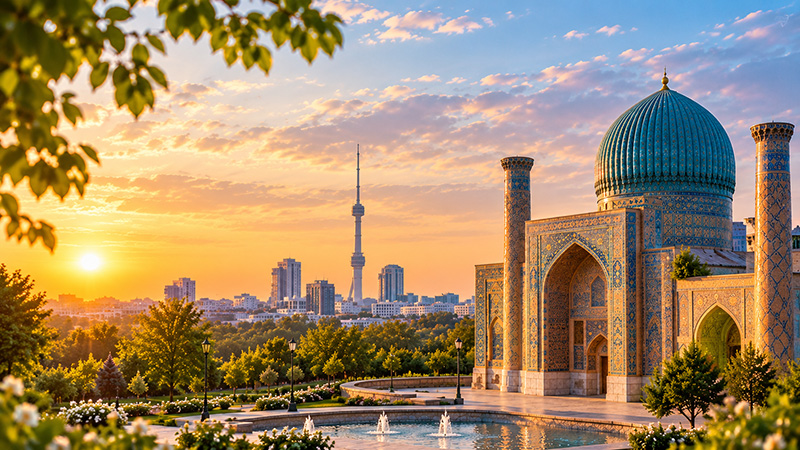
Tashkent is often treated as a transit city: you fly in, spend the night and head straight for the train to Samarkand. That's a mistake. Within a few kilometers, three different cities coexist here: old Tashkent with its madrasahs, mahallas and bazaar; Soviet Tashkent, rebuilt from scratch after the 1966 earthquake; and new Tashkent, with museums that opened literally in the last few months.
This guide brings together Tashkent's main sights, a ready-made itinerary for 1 and 2 days, and practical tips: how to get around, how much time to allow, and what you can skip if time is short. Each place has its own detailed article, with links given in the text.
How many days you need for Tashkent
- 1 day — the minimum to see the essentials: Hast-Imam, Chorsu Bazaar, a couple of metro stations and the city center. The day will be packed, but entirely doable.
- 2 days — the optimal choice. You give the first day to the old city and the second to Soviet and modern Tashkent, museums and evening strolls.
- 3 days or more — if you want to visit museums without rushing, go to the theatre, or take a trip to the Chimgan mountains.
The full route covering every stop in this article takes 8–10 hours. If you only go to the most important places, 4–5 hours is enough.
Hast-Imam — the heart of old Tashkent
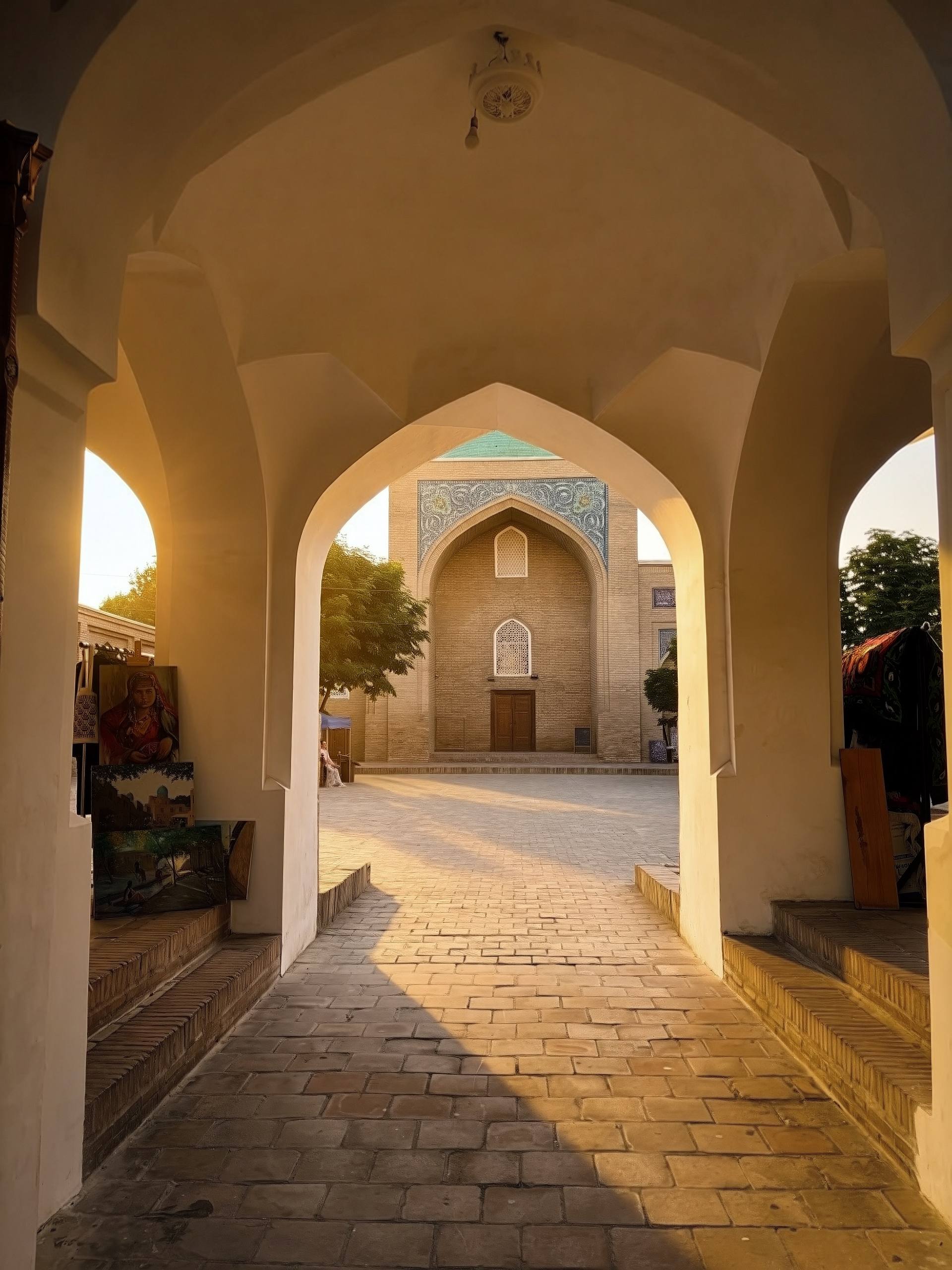
If there's one place in Tashkent worth coming for, it's the Hazrati Imam complex, which Tashkent residents simply call Hast-Imam. Beyond the modern streets, a square suddenly opens up with blue domes, madrasahs and mosques from the 16th to 20th centuries.
The complex's main buildings:
- The Barak-Khan Madrasah (16th century) — a tall portal with two blue domes, a symbol of the old city. Craft workshops now operate in the former khujras.
- The Tillya-Sheikh Mosque — the "golden sheikh," across from Barak-Khan.
- The Muyi Muborak Madrasah (the Quran museum). It used to house the oldest Quran manuscript, made by order of Caliph Uthman in the 7th century. It has now been moved to the Center of Islamic Civilization, but the museum still operates. There you can see a copy of the book made at the Hermitage in 1905 and a collection of ancient manuscripts.
- The mausoleum of Kaffal al-Shashi (1541) — the grave of a 10th-century theologian around which the whole ensemble grew.
An important detail that old guidebooks get wrong: the famous Uthman Quran is no longer kept at the Muyi Muborak Madrasah. In November 2025 it was moved to the new Center of Islamic Civilization, described below.
Hast-Imam is especially beautiful in the evening, when the lighting on the domes and minarets comes on.
👉 In detail: Hast-Imam in Tashkent: History, Ancient Madrasahs and the Uthman Quran
The Center of Islamic Civilization — a new museum next to Hast-Imam
The Center opened on March 17, 2026, right on the grounds of the Hazrati Imam complex, and its 65-meter turquoise dome is visible from afar. Already in April, the museum entered the Guinness World Records as the largest museum of Islamic civilization by exhibition area.
The exhibition is built as a journey through time: from the pre-Islamic states of Central Asia, through the era of al-Khwarizmi, Ibn Sina and Biruni, to the Timurids and modern Uzbekistan. The central place is occupied by the Quran Hall with the Uthman Mushaf.
- Time needed: about 2 hours
- Opening hours: daily, 9:00–22:00
- Tickets: from 90,000 UZS; it's best to check prices on the official website before your visit
👉 In detail: The Center of Islamic Civilization in Tashkent: What to See and Why It's Worth Visiting
The mahalla along the canal and Chorsu Bazaar
Next to the complex, an old mahalla — a residential neighborhood — remains along the ancient Kalkauz canal. You can walk through it and see old adobe houses where ordinary Tashkent families live. Tourists rarely see this side of Tashkent, even though it's a stone's throw from the main sights.
It's convenient to walk from Hast-Imam to Chorsu (a stroll of about 20 minutes) through another part of the traditional mahalla, where the tourist street Zarkaynar has recently appeared. The façades of residential houses have been restored, and tourist shops, workshops and coffee houses have opened there. Also located there is Zan Makon — the women's museum. A very curious little place.
Chorsu Bazaar is Tashkent's most famous market. Trading at this crossroads has gone on since about the 10th century, while the famous turquoise dome appeared quite recently, in the 1980s: it's an example of Tashkent modernism that UNESCO has noted.
What to do at Chorsu:
- try qurt in the dairy rows under the main dome;
- buy dried fruit, nuts and spices for plov — you're given samples before you buy;
- grab a warm flatbread straight from the counter;
- have lunch in the "food row": naryn, khanum, qazi, shashlik.
Haggling is acceptable in the souvenir rows, less so in the food ones. A few words of Uzbek work better than any bargaining.
👉 In detail: Chorsu Bazaar in Tashkent: History, What to Buy and What to Try
Shaykhantaur — a quiet island in the center
Between Abdulla Qodiriy and Alisher Navoi streets, the Shaykhantaur memorial complex has survived: the 14th-century mausoleum of the Sufi sheikh Khovendi at-Tahur and the Tole Bi mausoleum with its unusual pointed tent-shaped dome.
For guests from Kazakhstan, this place is special: Tole Bi is one of the best-known biys in Kazakh history, a co-author of the "Zheti Zhargy" code of laws. That's why Shaykhantaur often becomes a must-stop for Kazakhstani travelers.
👉 In detail: Shaykhantaur in Tashkent: History, the Mausoleum of Sheikh Khovendi at-Tahur and Tole Bi
The Tashkent metro — an underground museum
Central Asia's first metro opened in 1977, and each station here is designed differently. It's worth riding a couple of extra stops just for the architecture.
Stations worth seeing:
- "Kosmonavtlar" — blue vaults and portraits of cosmonauts, the calling card of the Tashkent metro;
- "Alisher Navoi" — domes, niches and mosaics inspired by the poet's works;
- "Paxtakor" — a station dedicated to cotton;
- "Mustaqillik Maydoni" — one of the most ornate stations;
- stations of the Chilanzar Line — marble, crystal chandeliers, national ornaments.
Photography is now freely allowed in the metro. The metro runs from 05:00 until midnight and remains the fastest way to get around the city.
👉 In detail: The Tashkent Metro
The Monument of Courage — a story that changed the city
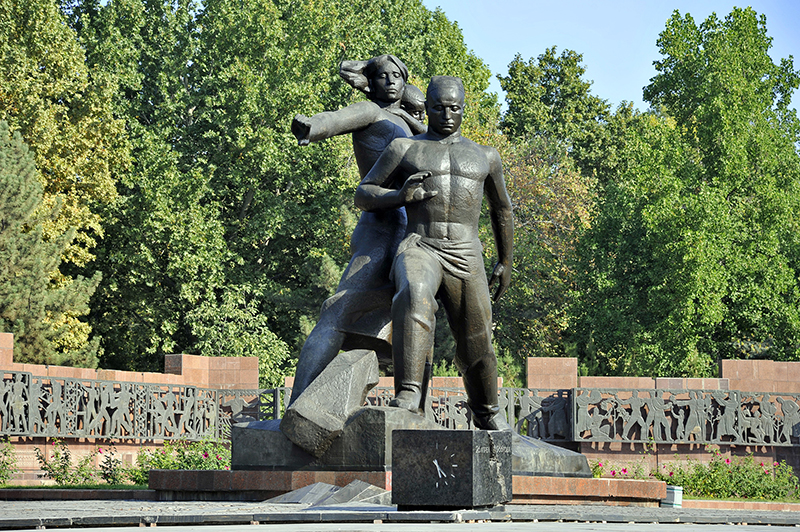
To understand why central Tashkent looks the way it does, start with the Monument of Courage. A black cube split by a crack and a bronze family are dedicated to the earthquake of April 26, 1966. On the clock face the hands stopped forever — at 5:23.
More than 300,000 people were left homeless then, and the city center had to be built anew. The wide avenues, squares and Soviet modernism that tourists today see as the "face of Tashkent" appeared precisely after the disaster.
Walk all the way around the monument: behind the main sculpture stand 14 steles that tell the story of the city's rebuilding.
👉 In detail: The Monument of Courage in Tashkent: the Story of the 1966 Earthquake
The Navoi Theatre, Broadway and Amir Timur Square
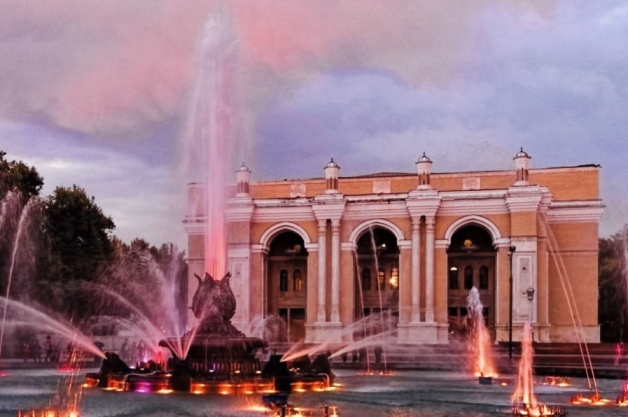
The Alisher Navoi Theatre is worth seeing even for those who don't plan to attend a performance. The building was designed by Alexey Shchusev and opened in 1947. In the final stage of construction, Japanese prisoners of war worked on it, taught Uzbek ganch carving by master Tashpulat Arslankulov. The foyers are decorated in the traditions of six regions of Uzbekistan.
👉 In detail: The Alisher Navoi Theatre in Tashkent: History, Architecture and What to See
Nearby are Mustaqillik Square, the country's main square, and Broadway (Sayilgoh Street), a pedestrian street with street artists and cafés. It leads to Amir Timur Square — the city's central square with the monument to Timur. It's a convenient place to end the day, especially in the evening.
👉 Amir Timur Square: History and What to See Nearby
The Museum of Applied Arts — Tashkent's most beautiful house
The museum occupies the late-19th-century mansion of the diplomat Alexander Polovtsev. The rooms were painted by craftsmen from all over Turkestan, so the house itself is no less interesting than the collection: silk, suzani, carpets, ceramics, wood carving.
- Address: 15 Rakatboshi St.
- Opening hours: daily 9:00–18:00, the ticket office closes an hour earlier
- Time needed: from 40 minutes to an hour and a half
For this museum we have a free audio tour: a good way to try the CityInsider format before setting off on the big route.
New Tashkent: the Center of Contemporary Art
In September 2026, CCA Tashkent opened on Amir Timur Street: an old tram depot from 1912 was turned into a space for exhibitions, film screenings and concerts. Entry is free with advance registration, and it's closed on Mondays.
👉 In detail: The Center of Contemporary Art in Tashkent: a New Place on the City Map
A 1-day itinerary in Tashkent
The route runs from the Monument of Courage through the old city to the center. Between the stops you can walk, take the metro or a taxi.
- The Monument of Courage — 10–15 minutes
- The Ankhor canal embankment — optional
- Hast-Imam and the Center of Islamic Civilization — 1–2 hours
- The mahalla along the Kalkauz canal — 20 minutes on foot
- Chorsu Bazaar — 40–90 minutes, lunch here too
- The metro — 10–20 minutes, a couple of beautiful stations on the way to the center
- The Museum of Applied Arts — 40–70 minutes
- Theatre Square and the Navoi Theatre — 10–15 minutes
- Mustaqillik Square — optional
- Broadway and Amir Timur Square — 30–50 minutes, best at sunset
If time is short, keep Hast-Imam, Chorsu, the metro and Amir Timur Square: that's 4–5 hours.
A 2-day itinerary
Day 1. The old city. Hast-Imam and the Center of Islamic Civilization in the morning, the mahalla, lunch at Chorsu, and in the afternoon, Shaykhantaur. In the evening, return to Hast-Imam to see the lighting.
Day 2. Soviet and new Tashkent. The Monument of Courage, a ride through the beautiful metro stations, the Museum of Applied Arts, the Navoi Theatre, CCA Tashkent. The evening — Broadway and Amir Timur Square.
How to get around Tashkent
- The metro — the fastest and most predictable way, with no traffic jams. It runs from 05:00 until midnight.
- Taxi — convenient and inexpensive, easiest to order through an app.
- On foot — the old city (Hast-Imam → mahalla → Chorsu) and the center (theatre → Broadway → square) are best covered on foot.
How to get to Tashkent and move on to Samarkand or Bukhara is covered in the article "How to Get Around Uzbekistan".
When to go to Tashkent
The best time is spring and autumn: warm but not hot, so you can walk all day. In summer it can get very hot during the day, so it's better to shift walks to the morning and evening and retreat to museums and the metro during the hottest hours. More in the article "Can You Travel to Uzbekistan in Summer?".
The best way to see Tashkent
There are three formats; choose according to how you like to travel:
- On your own with the CityInsider audio guide. The route from this article, only with the live voice of a licensed guide, a map, local tips and the ability to ask questions along the way. You can shorten the route or stretch it over two days. View the Tashkent audio tour →
- An evening group tour of the old city. Hast-Imam at sunset, the mahalla along the canal, silk, suzani and ceramics workshops, and a finale at Chorsu. Starts at 17:00, 3–4 hours. More about group tours →
- With a private guide — if you want a route tailored to your interests. Our guides →
Frequently asked questions
How many days do you need to see Tashkent?
You can see the essentials in 1 day, and comfortably in 2 days.
Can you see Tashkent on your own?
Yes. The city is safe, the metro and taxis are convenient, and metro signs are duplicated in Russian. To understand what you're looking at, an audio guide is handy. More about safety in the article "Safety in Uzbekistan".
What can you see in Tashkent for free?
Hast-Imam from the outside, Chorsu Bazaar, the Monument of Courage, Broadway and Amir Timur Square, Shaykhantaur. Entry to CCA Tashkent is also free, with registration.
Where can you find a guide in Tashkent?
In high season there aren't enough guides, so it's better to arrange one in advance. How to do that is covered in the article "How to Find a Guide If You're Traveling to Uzbekistan".