Islamic Civilization Center in Tashkent: What to See and Why It's Worth a Visit
The Center officially opened on March 17, 2026, and by April the museum had already been registered by Guinness World Records as the largest museum of Islamic civilization by exhibition area. The museum's exhibition space covers 7,772.8 m².
But the numbers aren't really the point. What makes the Center interesting is that it tells the story of the region far more broadly than just the history of religion. Here you can see how, over thousands of years, cities, sciences, culture, architecture and education developed on the territory of modern-day Uzbekistan.
Where the Islamic Civilization Center is located
The Center was built on the grounds of the historic Hazrati Imam complex in Tashkent. This is especially convenient for tourists: a visit to the Center can easily be combined with a walk through one of the capital's most fascinating historic districts. The official address is Tashkent, Almazar district, Karasaroy 47.
Nearby are other major landmarks, including the Tillya Sheikh Mosque, the Barak Khan Madrasah, and the Mausoleum of Kaffal Shashi.
In other words, it's worth visiting not as a standalone museum, but as part of a broader route through the old city of Tashkent.
A huge turquoise dome
Even if you have very little time for the museum, it's almost impossible to miss the building.
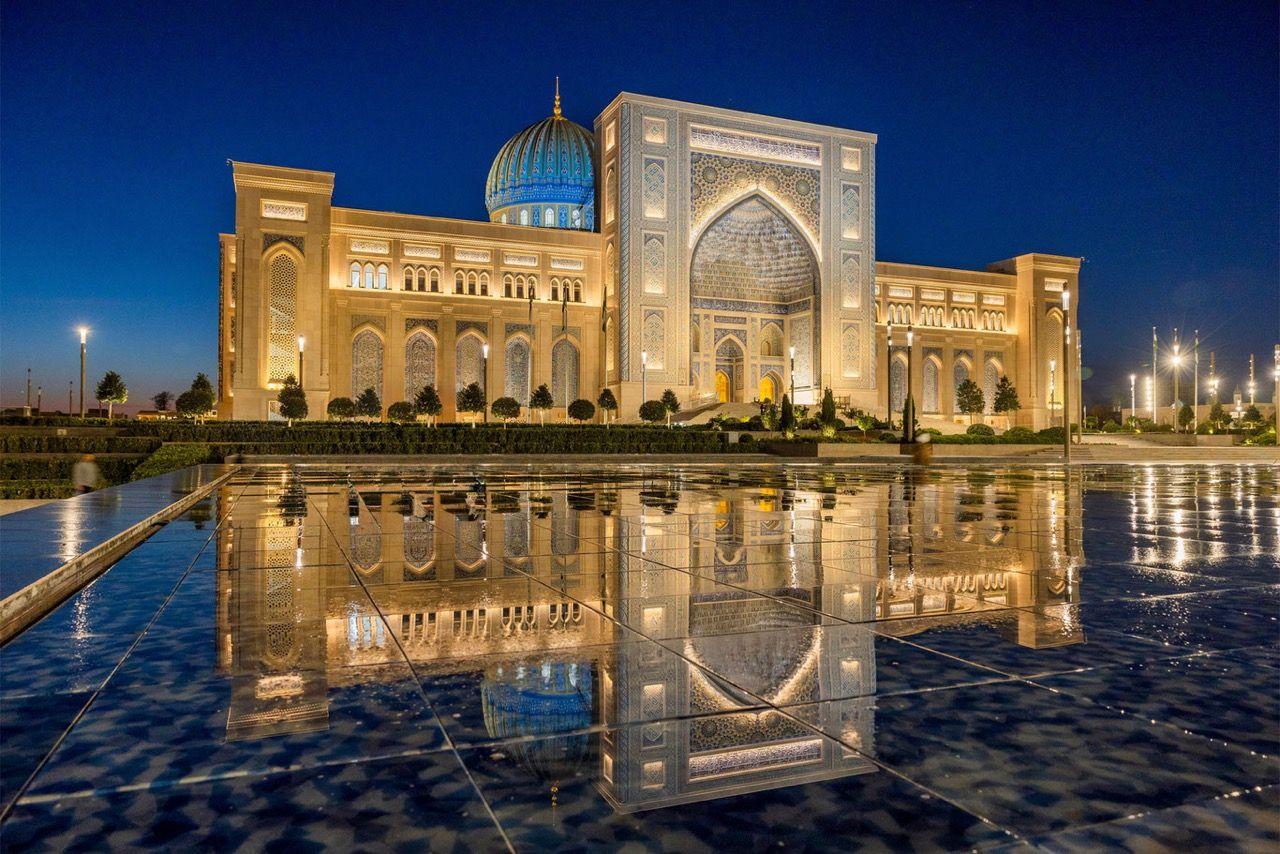
The Center is a monumental three-story structure 161 meters long and 118 meters wide. A dome 65 meters high rises above the central section. The complex as a whole occupies about 10 hectares.
The architecture draws on traditional Uzbek motifs, ornaments and elements of Islamic design, yet the building itself was created as a modern museum complex.
It has four large entrance portals, and the façades are decorated with calligraphy and quotations from the Quran and hadith.
The building is especially striking in the evening, when the lighting comes on and the façade is reflected in the water on the square in front of the Center.
What's inside
The exhibition of the Islamic Civilization Center is designed as a grand journey through time.
One of the museum's main ideas is to show the region's history not only through the Islamic period, but also through the more ancient civilizations that existed on the territory of present-day Uzbekistan.
Among the main thematic sections are the pre-Islamic period, the First and Second Renaissances, and the modern history of Uzbekistan.
Pre-Islamic history
The journey begins long before the arrival of Islam in Central Asia.
Visitors learn about the ancient states and cultures of the region, important archaeological finds, and the development of cities and trade routes.
One of the exhibition's most interesting sections is the "Wall of Civilizations and Discoveries." This is a large-scale installation, 52 meters long and 8 meters high, dedicated to the region's ancient history and the greatest achievements of its inhabitants.
For visitors, this is a good way to see the history of Uzbekistan not as a set of isolated monuments, but as one long story that began thousands of years ago.
The First Renaissance
The exhibition then moves on to the era when Central Asia became one of the world's major centers of science and learning.
Familiar names appear here: Muhammad al-Khwarizmi, Abu Ali ibn Sina (Avicenna), Abu Rayhan al-Biruni, al-Farabi and other great scholars of the East.
Their work shaped the development of mathematics, medicine, astronomy, philosophy and other sciences.
One of the museum's distinctive features is its use of multimedia technology. The aim isn't simply to display history behind glass, but to make it interactive and easy for visitors to grasp.
The Second Renaissance
Special attention is given to the Timurid era and the development of Samarkand and other major cities of the region.
For tourists, it's especially interesting to see this period in a broader context: not only through Registan or the Gur-Emir Mausoleum, but through the development of science, architecture, art and education.
The Quran Hall and the Uthman Quran
The centerpiece of the museum is the Hall of the Holy Quran.
Its main exhibit is the famous Uthman Quran — the oldest surviving manuscript of the Quran, associated with the name of the third Rightly Guided Caliph, Uthman ibn Affan. This artifact is considered one of the most famous relics of the Islamic world. The Center also displays other rare Quran manuscripts from different historical periods.
The hall itself sits beneath the huge central dome and forms the architectural heart of the entire building.
For anyone interested in the history of manuscripts, it's especially fascinating to see not just the books themselves, but also to learn how they were created, preserved and passed down through generations.
More than just a museum
The Islamic Civilization Center was conceived as more than simply a museum.
The building houses research and educational spaces, a library, manuscript restoration and digitization laboratories, and conference facilities. The library has nearly 300 seats and covers about 3,100 m².
There's also a space for children — an interactive exhibit designed to introduce young visitors to history and culture through play and modern technology.
So the Center can appeal not only to tourists who want to see ancient artifacts, but also to those who prefer modern, interactive museums.
How much time to allow for a visit
To properly explore the Center, it's best to set aside about two hours. That's the standard length of a group tour for visitors.
That said, it's easy to spend even longer inside: the exhibition is large, and beyond the museum halls there's a library, a children's zone and other spaces.
The Center is open daily from 9:00 AM to 10:00 PM.
Admission depends on the type of ticket. Rates published in 2026 started from 90,000 soums, while a tourist ticket for foreign visitors in a group cost 425,000 soums. Rates and visiting conditions may change, so it's best to check the current information on the Center's official website before your visit.
When to come
For a first visit, a good option is to arrive in the afternoon and combine your visit to the Center with a walk through Hazrati Imam.
During the day, it's worth focusing on the architecture of the complex itself, and closer to evening you can see how the building looks once the lighting comes on.
One more tip: don't try to rush through the museum. There's a lot of information here that's easy to miss, especially in the interactive exhibits and historical sections.
Why the Islamic Civilization Center matters for Tashkent
For a long time, Tashkent remained, for tourists, a convenient city to pass through on the way to Samarkand or Bukhara. Today, the capital has more and more places of its own worth stopping for.
The Islamic Civilization Center reflects this shift well. It brings together the region's ancient history, the legacy of its great scholars, manuscripts and architecture, together with modern museum technology.
And most importantly — after visiting Hazrati Imam and the Center itself, many of Tashkent's familiar landmarks start to feel a little different. Behind every mosque, madrasah or old quarter turns out to be not a separate story, but part of the larger cultural space of Central Asia.
📍 Islamic Civilization Center in Tashkent
Address: Karasaroy 47, Almazar district
Hours: daily, 9:00 AM–10:00 PM
Official website: iccu.uz
Tip from CityInsider: It's easy to combine the Center with our group tour "Old City at Sunset." That way, in a single walk you can see both historic landmarks and one of the city's newest museums.