Barak-Khan Madrasah in Tashkent: History, Architecture, Workshops and How to Visit
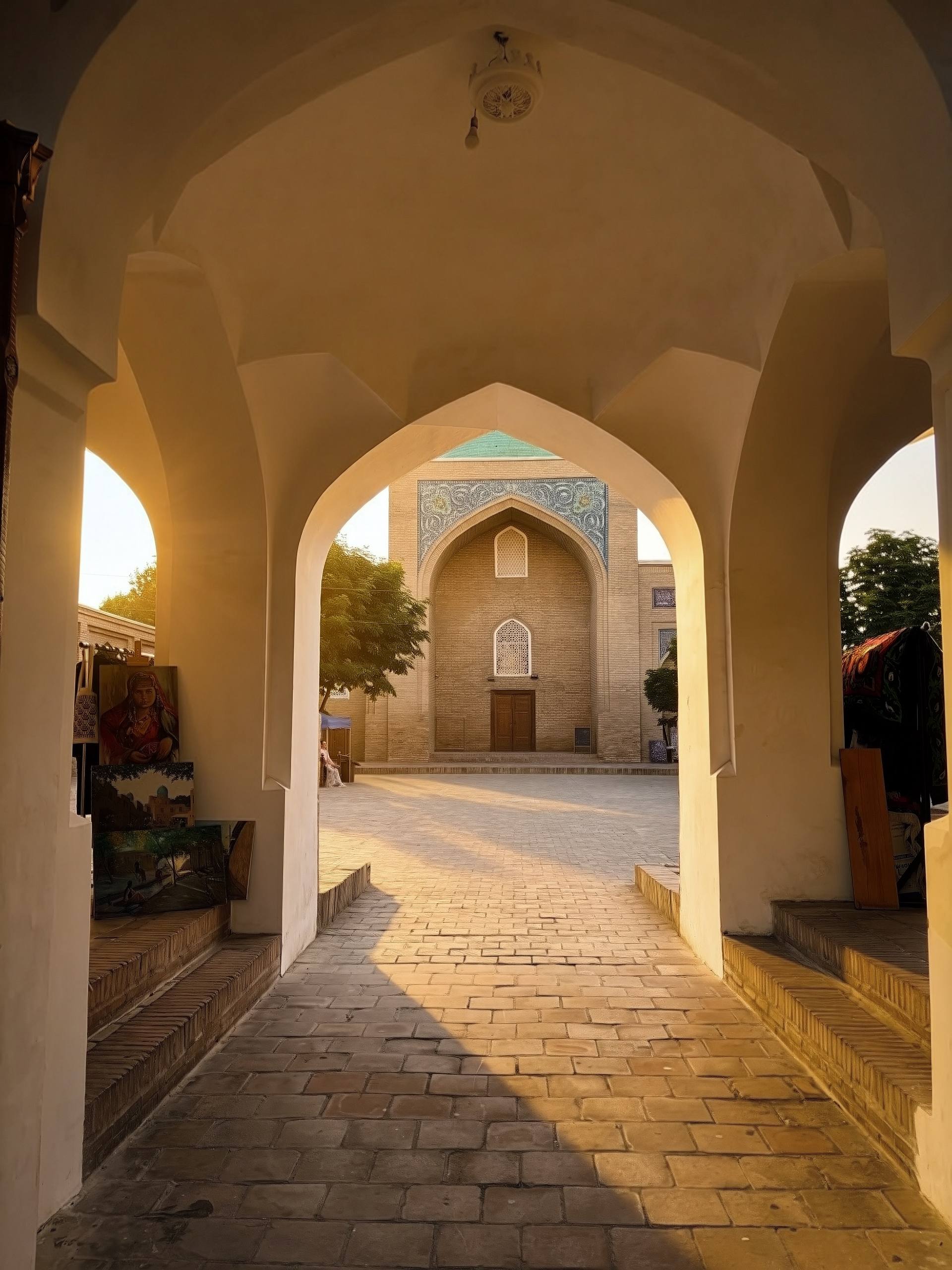
If you come to Hast-Imam (Hazrati Imam) Square in old Tashkent, your eyes will be drawn at once to a monumental brick building with a tall azure portal and domes of unusual shape. This is the Barak-Khan Madrasah — one of the main architectural monuments of the capital of Uzbekistan, which has survived almost five centuries, devastating earthquakes and changing eras.
Unlike many museums with their glass display cases, the Barak-Khan Madrasah is a thoroughly living place. Here the medieval history of the Shaybanid dynasty sits alongside the delicate scents of wood and lacquer: in the former student rooms, hereditary woodcarvers, calligraphers and miniature painters now work.
In this guide we will go through the history of the Barak-Khan Madrasah: how the grandson of the great Ulugbek laid a tomb here, why Barak-Khan himself never came to rest in the mausoleum built for him, which hidden details of the façade deserve attention, and how to plan your visit.
Practical information for tourists
- Exact address: Tashkent, Almazar district, Karasaray Street, 107/3 (the historic Hast-Imam Square ensemble).
- Opening hours: the madrasah courtyard is open daily from 09:00 to 21:00. Most craft workshops and souvenir shops are open from 10:00 to 18:00–19:00.
- Admission: entry to the madrasah courtyard is free.
- How to get there: the easiest way is the metro to Chorsu or Gafur Gulom station (about 15–20 minutes on foot from either, through the colorful streets of the Old City), or a 10–15-minute taxi ride from central Tashkent (landmark in Yandex Go — “Barak-Khan Madrasah” or “Hast-Imam Square”).
- How much time to allow: for an unhurried look at the madrasah itself and the workshops — 40–60 minutes, and for the whole of Hast-Imam Square together with the neighboring Islamic Civilization Center — 2 to 3 hours.
History of the Barak-Khan Madrasah: three rulers and two centuries of dynasties
Short reference notes often say that the Barak-Khan Madrasah was built in a single year. In fact, what stands before us is a complex architectural puzzle that came together over several decades of the 16th century — an era when power in Maverannahr passed from the Timurids to the new Uzbek dynasty of the Shaybanids.
However, the Tashkent rulers of that time had a remarkable pedigree that united both dynasties.
The first Shaybanid ruler of Tashkent was Suyunchkhodja Khan (Suyunidj Khan). On his mother’s side he was the grandson of the great astronomer and ruler of Samarkand, Mirzo Ulugbek (his mother was Ulugbek’s youngest daughter, Rabia Sultan Begim). Suyunchkhodja Khan was highly educated, loved poetry and invited the best scholars, architects and writers of his time to Tashkent.
The history of the complex unfolded in three stages:
- The first mausoleum (around 1530–1532): In the eastern part of the present building, over the burial of Suyunchkhodja Khan himself (who died in 1525), his sons raised a majestic tomb. The court architect Gulyam Khusein crowned it with a tall double turquoise dome on a slender drum, for which the people nicknamed the mausoleum “Kok-Gumbaz” (the Blue Dome).
- The khanaka and the second mausoleum: Nearby, earlier still, at the turn of the 15th–16th centuries, stood a smaller nameless single-domed mausoleum (by one version, intended for the ruler’s eldest son, Keldi Muhammad Khan).
- Unification into a madrasah under Barak-Khan (mid-16th century): When the ruler’s youngest son, Navruz Ahmed Khan, came to power, he ordered both mausoleums to be joined into a single brick quadrangle with an inner courtyard and student cells, the khujras. Thus the memorial complex became a religious academy — a madrasah.
Who was Barak-Khan and why was his mausoleum left empty?
The real name of the madrasah’s founder is Navruz Ahmed Khan, because he was born on the day of the spring equinox, the holiday of Navruz. But he went down in history under the resounding nickname Barak-Khan.
The word “baraka” in the East means “divine grace,” “blessing” and “unfailing luck.” His subjects considered Navruz Ahmed Khan an exceptionally lucky commander and ruler, under whom Tashkent experienced a true heyday. In 1551 he even became supreme khan of all the Shaybanids.
This is the source of one of the most intriguing historical ironies of Tashkent: although the madrasah bears Barak-Khan’s name and includes the tomb built for him, the ruler himself is not buried here. In 1556 Navruz Ahmed Khan died suddenly during a campaign in Samarkand and was buried there — in the honorary cemetery beside the mazar of the Sufi saint Khoja Ahrar. The mausoleum in Tashkent remained a symbolic tomb.
Architecture: a Samarkand hand in the heart of Tashkent
If you have already been to Samarkand or Bukhara, then looking at the Barak-Khan Madrasah you will notice at once: its appearance is atypical for Tashkent and much closer to the Samarkand architectural school of the 15th century. This is no accident — the grandsons and great-grandsons of Ulugbek strove to bring the capital splendor of Samarkand to Tashkent.
The details worth special attention during your visit:
- Asymmetrical composition with two domes: Unlike classic madrasahs, where minarets or symmetrical halls stand by the main entrance, the Barak-Khan building has two ancient mausoleums built right into it, on the axis and at the corner. It is they that create the building’s unique stepped silhouette.
- The main portal (peshtak) with a vault in the kolab-kori technique: The entrance arch is decorated with a complex geometric ornament (girih), set mosaic and glazed brick in deep blue, turquoise and white shades. For the first time in Tashkent architecture, five-pointed and eight-pointed stars of carved kashin mosaic were used in the tympana of the arch.
- A poetic chronicle on the façade and the legacy of Vasifi: The original tile epigraphy of the main portal has, unfortunately, not survived — the building suffered badly from devastating earthquakes (especially that of 1868) and has been restored many times. However, 16th-century written sources tell us that the façade of the madrasah was once adorned with solemn qasida verses by the court poet and mentor of rulers Zayn ad-Din Vasifi, who extolled the beauty of the new building. Remarkably, the poet himself found eternal rest very close to this place — his grave is in the mausoleum of Kaffal ash-Shashi.
- The inner courtyard and khujras: Passing through the vaulted vestibule, you enter a cozy quadrangular courtyard. Around its entire perimeter are single-story pointed niches and doors leading to the khujras — small vaulted rooms where for four centuries student-talibs lived and pored over treatises.
Tested by the elements: the earthquakes of 1868 and 1966
The fate of the monument was dramatic. In 1868 Tashkent was hit by a very powerful earthquake that dealt the complex a heavy blow: the famous 22-meter blue dome of Suyunchkhodja Khan’s mausoleum (“Kok-Gumbaz”) collapsed, and the vaults and the upper part of the main portal cracked.
Archival photographs from the late 19th and early 20th centuries show part of the madrasah standing half-ruined, with storks nesting on the surviving domes. The first strengthening works began in 1904–1905, in the 1920s–1930s the monument was taken under state protection, and after the Tashkent earthquake of 1966 serious scientific restoration was carried out here, with the participation of the best folk master craftsmen, the ustos.
A curious fact from the 20th century: for half a century — from 1950 to 2007 — the Barak-Khan Madrasah housed the official residence of the Muslim Board of Central Asia and Kazakhstan (later the Muslim Board of Uzbekistan), until in 2007, during the large-scale reconstruction of Hast-Imam Square, a new building was erected for the institution next door.
The Barak-Khan Madrasah today: a city of masters inside the khujras
Today the inner courtyard of the Barak-Khan Madrasah has become one of the best centers of traditional applied art in Tashkent. In the cool stone khujras, where students’ oil lamps once burned, creative workshops and craftsmen’s shops are now open.
Why it is worth stopping by even if you do not plan to buy souvenirs:
- Masters at work before your eyes: This is not just a place where factory goods are resold. In many khujras the masters themselves sit at work — you will hear the measured tapping of chisels on wood, see a pattern applied with the finest brush to papier-mâché boxes, and watch a multilayered islimi ornament being carved into elm and walnut.
- Copper chasing and ceramics: The shops offer lyagan dishes, aftoba jugs and piyala bowls from the country’s main ceramic centers — blue Rishtan ceramics, and the warm Gijduvan and Tashkent schools.
- Book stands (lauh) and woodcarving: The calling card of the local carvers is the folding wooden book stand (lauh), carved from a single block of wood without a single nail or drop of glue.
- Textiles, suzani and silk: Here you can look at antique and modern embroidered suzani panels, Margilan khan-atlas and adras, skullcaps and handmade silk scarves.
A guide’s tip: Do not be shy about stepping through the small doors and greeting the masters. Many of them are craftsmen of the third and fourth generation who will gladly show you their tools in a couple of minutes and tell you how Bukhara chasing differs from Kokand chasing.
Where is the Quran of Uthman? An important clarification for 2026
Many old guidebooks and tourist websites on the internet still say that the oldest manuscript, from the 7th century — the Holy Quran of Caliph Uthman (the Mushaf of Uthman) — is kept in the Barak-Khan Madrasah or in the neighboring Muyi Muborak Madrasah opposite.
Please note: this information is out of date. In November 2025 the authentic Mushaf of Uthman was ceremonially moved from the Muyi Muborak Madrasah to the specially designed Quran Hall of the new Islamic Civilization Center, whose gigantic 65-meter dome rises literally two minutes’ walk from the Barak-Khan Madrasah. So today you can combine both places in a single walk: first feel the authentic 16th-century atmosphere in the courtyard of Barak-Khan, and then see the priceless manuscript in a modern multimedia museum.
What to combine with a visit to the Barak-Khan Madrasah
The Barak-Khan Madrasah is a key point on a route through the Old City of Tashkent. To make your walk rich and logical, combine it with the following places nearby:
- The Hast-Imam (Hazrati Imam) ensemble: right on the same square as Barak-Khan stand the mausoleum of Tashkent’s holy patron Kaffal ash-Shashi (16th century), the Tilla-Sheikh Mosque, the Muyi Muborak Madrasah and the Friday Cathedral Mosque of Hazrati Imam with its two 53-meter minarets.
- The Islamic Civilization Center: a grandiose museum and educational complex next to the square, where the Quran of Uthman is now on display.
- Chorsu Bazaar: from Hast-Imam Square to the famous turquoise dome of the Chorsu market and the Kukeldash Madrasah it is only a 15–20-minute colorful walk through the authentic adobe mahallas of the Old City.
Useful tips before your visit
- Best time to visit and take photos: Come either in the morning at opening (when soft morning light falls directly on the madrasah’s eastern entrance portal and there are no tour buses yet), or an hour before sunset — in the evening the beautiful architectural lighting comes on in Hast-Imam Square and the heat subsides.
- Dress code: There are no strict restrictions in the courtyard of the Barak-Khan Madrasah itself, but since the building is part of the active Hast-Imam religious complex, for a comfortable visit to the neighboring mosques and the mausoleum it is better to choose clothing that covers shoulders and knees.
- Paying for purchases from the masters: Although some craftsmen accept payments by local cards, for buying souvenirs and handmade items be sure to carry cash in Uzbek sum (or small dollar bills) — it is easier and more pleasant to bargain that way.
Frequently asked questions (FAQ)
How much does it cost to enter the Barak-Khan Madrasah in Tashkent? Entry to the inner courtyard of the Barak-Khan Madrasah and a visit to the craft workshops are completely free.
What are the opening hours of the workshops inside the madrasah? The courtyard itself is open from 09:00 to 21:00, but the applied-art masters and souvenir shops in the khujras usually work from 10:00 in the morning to 18:00–19:00 in the evening.
Why is the madrasah called Barak-Khan? The building is named after the 16th-century Shaybanid ruler of Tashkent, Navruz Ahmed Khan, whom the people nicknamed “Barak-Khan” (from the word baraka — “blessed,” “lucky ruler”). It was by his decree that two earlier mausoleums were joined into the madrasah building.
Is it true that Barak-Khan is buried inside this madrasah? No, this is one of the best-known historical paradoxes of Tashkent. In the eastern part of the madrasah rests Barak-Khan’s father — the ruler Suyunchkhodja Khan (grandson of Mirzo Ulugbek). Barak-Khan himself built a tomb here for himself, but died in Samarkand in 1556 and was buried there, so his mausoleum in Tashkent remained empty.
Explore the Barak-Khan Madrasah and Old Tashkent with an audio guide at your own pace
On Hast-Imam Square it is easy to take a couple of beautiful photos in five minutes and walk on, never learning what dramas of the Shaybanids, secrets of medieval builders and stories of old mahallas are hidden behind these walls.
Right at the Barak-Khan Madrasah you can begin getting to know the history of the place with the live audio guide format of CityInsider, and then continue on a big independent journey across the whole city. In our audio tour of Tashkent a licensed guide will lead you step by step from the streets of the Old City and Hast-Imam Square to Chorsu Bazaar, the best metro stations and masterpieces of 20th-century architecture — with rare archive photographs, an offline map and tips on where to try the best plov. No crowds, no rush, and entirely at your own pace!