Hast-Imam in Tashkent: History, Ancient Madrasahs and the Uthman Quran
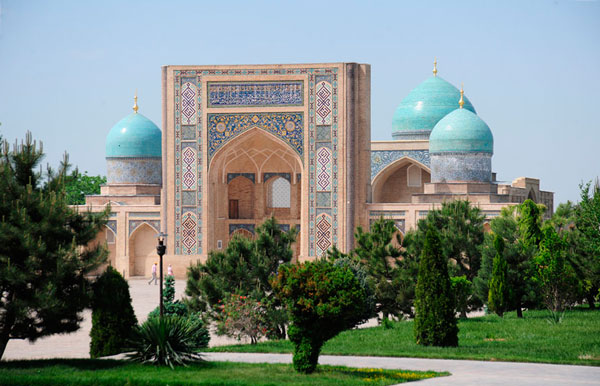
Beyond the modern streets, a spacious square suddenly opens up, with blue domes, ancient madrasahs, mosques and a mausoleum. This is the Hazrati Imam complex, more commonly called Hast-Imam in Tashkent.
For a traveler, this is one of the main landmarks of old Tashkent. Here you can see monuments spanning the 16th to 20th centuries, learn the story of the outstanding theologian Kaffal al-Shashi, step inside old madrasahs, and nearby visit the modern Center of Islamic Civilization, where the famous Uthman Quran is now on display.
What also makes Hast-Imam interesting is that it isn't a museum display. It's a working religious and historical complex that remains an important part of Tashkent's daily life.
Why the complex is called Hast-Imam
The name is linked to Abu Bakr Muhammad ibn Ali Ismail al-Kaffal al-Shashi — an outstanding theologian, scholar and religious figure of the 10th century.
His grave became the center around which an entire religious ensemble gradually took shape. That's exactly why the complex is named Hazrati Imam, while everyday speech settled on the shorter Hast-Imam.
The site for the complex was chosen next to the ancient grave of Kaffal al-Shashi. Over time, a mausoleum, mosques and madrasahs appeared around it, and today's ensemble brings together monuments from several eras.
Who was Kaffal al-Shashi
Kaffal al-Shashi lived in the 10th century and was one of the greatest Islamic scholars of his time.
He studied theology and Islamic law, researched hadiths, and left behind scholarly works. In Tashkent he is revered as one of the city's most important spiritual figures.
It was precisely his mausoleum that became the historical core of Hast-Imam.
Today's mausoleum building was constructed in 1541, during the Shaybanid era. Over the following centuries it was repeatedly repaired and rebuilt, but the memory of Kaffal al-Shashi has survived here to this day.
The mausoleum of Kaffal al-Shashi
The mausoleum stands slightly apart from the complex's central square.
It isn't the most imposing building at Hast-Imam, but it's precisely its history that explains why the whole ensemble is located here.
If you have time, don't just walk past quickly — pay attention to the mausoleum's architecture and imagine that for centuries students, theologians and pilgrims came here.
The Barak-Khan Madrasah — one of Hast-Imam's symbols
The complex's most recognizable building is the Barak-Khan Madrasah.
It dates to the 16th century and was built during the reign of Suyunchkhoja Khan, a grandson of Ulugbek. Today its tall portal flanked by two blue domes has become one of the symbols of old Tashkent.
The madrasah wasn't just a beautiful building.
Inside were khujras — small cells for students, and the madrasah itself was part of the city's religious and educational life.
Its architecture clearly shows forms typical of Central Asia: a massive portal, domes, brickwork and decorative ceramics.
Today craft workshops and small shops operate in its former rooms, so the madrasah can be seen not only as an architectural monument but as a living space.
The Tillya-Sheikh Mosque
Facing Barak-Khan stands the Tillya-Sheikh Mosque.
It belongs to a later period in the complex's history — its construction is linked to the 19th century, and the mosque was renovated in the early 20th century. Together with Barak-Khan and the mausoleum of Kaffal al-Shashi, it shapes Hast-Imam's main historical appearance.
The mosque's name is translated as "golden sheikh."
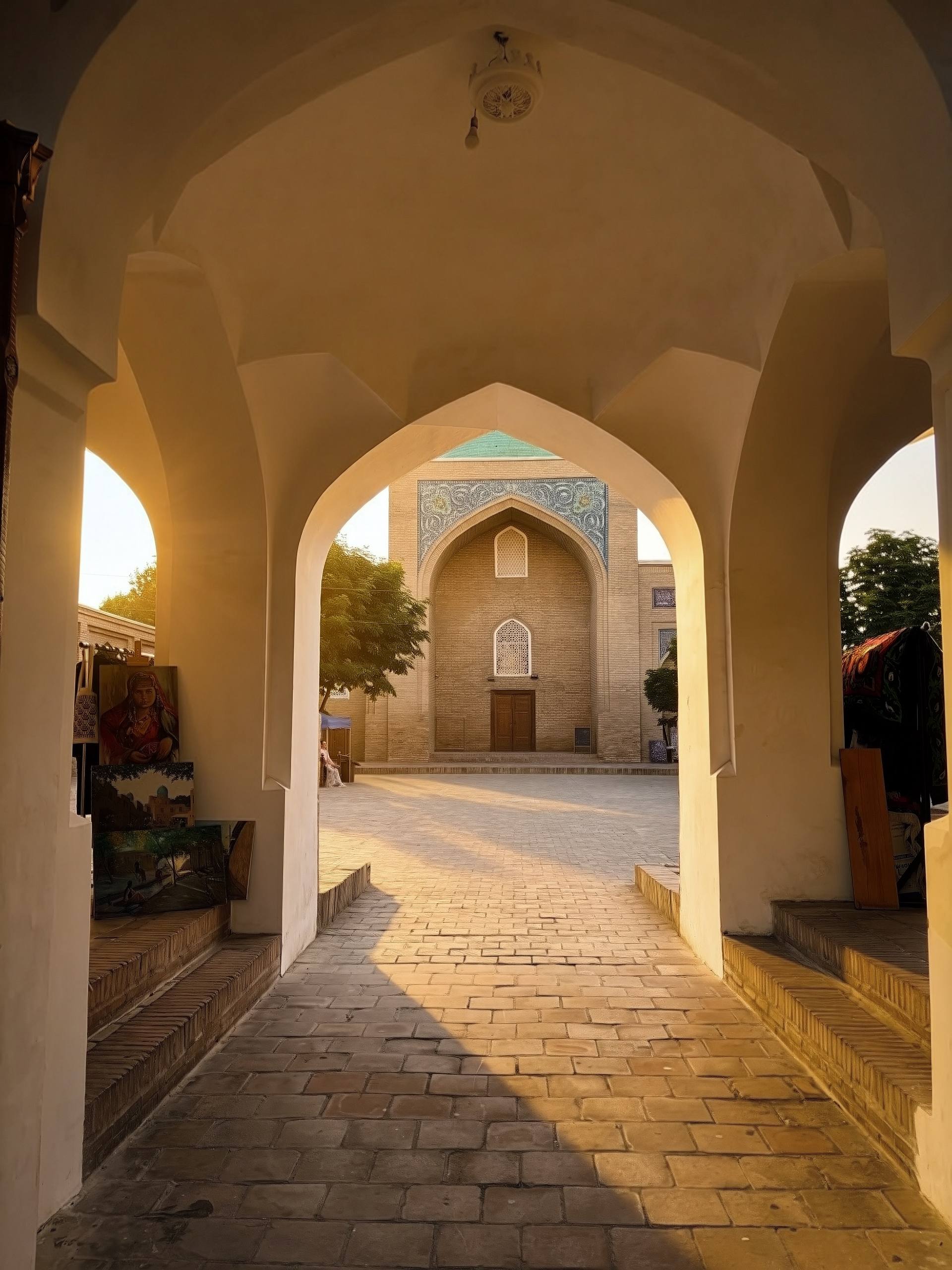
It's especially beautiful here in the evening, when the lighting picks out the domes, minarets and façades. Hast-Imam generally looks striking after sunset, when the daytime space turns into a more intimate and quiet historic quarter.
The Muyi Muborak Madrasah
Another historic building in the complex is the Muyi Muborak Madrasah.
The name can be translated as "the sacred hair" and is linked to a religious relic that tradition associates with the Prophet Muhammad.
The madrasah dates to the 16th century and for a long time was known above all for the library and the ancient Quran manuscript kept here.
But there's one modern detail worth knowing, which old guidebooks often get wrong.
Where is the Uthman Quran located now?
Now — it's no longer at Muyi Muborak.
On November 13, 2025, the famous Uthman Mushaf was officially moved from the Muyi Muborak Madrasah to the Center of Islamic Civilization of Uzbekistan. Today it is the main exhibit of the new center's Quran Hall.
So information on old websites and in old guidebooks saying a visitor should go to Muyi Muborak specifically for the Uthman Quran is now outdated.
Today you need to see the Uthman Mushaf at the Center of Islamic Civilization.
The Uthman Quran: one of the main relics of the Islamic world
The history of this manuscript is itself like a journey through the centuries.
The Mushaf is traditionally linked to the era of the third rightly-guided caliph, Uthman ibn Affan. In the 20th century the manuscript ended up in Tashkent after a long journey through Samarkand and St. Petersburg.
Today the Center of Islamic Civilization has built a dedicated Quran Hall, where the Uthman Mushaf is kept among other rare manuscripts.
According to the Center's official data, two surahs — "Al-An'am" and "Taha" — have survived completely intact in the preserved part of the manuscript, and a total of 2,108 verses have come down to us. In 2025, researchers also found seven pages of the manuscript previously believed lost.
This alone makes the Mushaf's story interesting not just from a religious standpoint, but a historical and scholarly one as well.
Why Hast-Imam and the Center of Islamic Civilization are worth visiting together
With the new center's opening, a visit to Hast-Imam has become much more interesting.
On one side — a historic ensemble that took shape around the grave of Kaffal al-Shashi.
On the other — a modern museum center that tells the story of Islamic civilization and Central Asia's heritage.
And between them there's a direct connection: one of Hast-Imam's main relics, the Uthman Mushaf, is now at the center of a specially built modern Quran Hall.
This creates a rare opportunity to see several centuries of history side by side in a single walk.
The Center of Islamic Civilization
The Center of Islamic Civilization opened in 2026.
The building was constructed next to the historic Hast-Imam complex and combines modern museum technology with traditional architectural motifs. The central dome reaches 65 meters, and inside are museum and research spaces.
The exhibition's main part is the Hall of the Holy Quran.
At its center is the Uthman Mushaf, surrounded by Quran manuscripts from different eras and regions. At the opening ceremony, the President of Uzbekistan called this hall the "soul" of the Center.
So today a traveler has two completely different ways to get to know Hast-Imam's history:
see the historic buildings themselves — and then look at Islamic civilization's heritage in a modern museum.
Interesting facts about Hast-Imam
The name Hast-Imam is linked to Kaffal al-Shashi. His grave became the complex's historical core.
The Barak-Khan Madrasah was built in the 16th century. It remains one of the most recognizable monuments of Old Tashkent.
Muyi Muborak is no longer where the Uthman Quran is kept. The manuscript was moved from there to the Center of Islamic Civilization on November 13, 2025.
Today the Uthman Mushaf is kept in the Quran Hall of the Center of Islamic Civilization.
Hast-Imam and the Center of Islamic Civilization are conveniently visited together. They stand next to each other and effectively tell two connected parts of one story.
🎧 Want to see Hast-Imam with a local guide?
You can simply come to the square, photograph Barak-Khan and move on.
But then it's easy to miss the most interesting part:
why the whole complex arose precisely here, who Kaffal al-Shashi was, what sets Barak-Khan apart from Muyi Muborak, and why today you need to look for the Uthman Quran not in the old madrasah, but in the new Center of Islamic Civilization.
On our Tashkent tour, we tell you all of this right on the spot and connect Hast-Imam with the Old City's other important sites.
And most importantly — you're not just following a group. CityInsider is your local guide in your phone: listen to the stories through your headphones, move at your own pace, and ask questions along the way.
Hast-Imam is also the final stop on our group tour "Tashkent: Old City at Sunset," where we walk through all of Old Tashkent's landmarks. You can check dates and sign up here