The Monument of Courage in Tashkent: the Story of the 1966 Earthquake
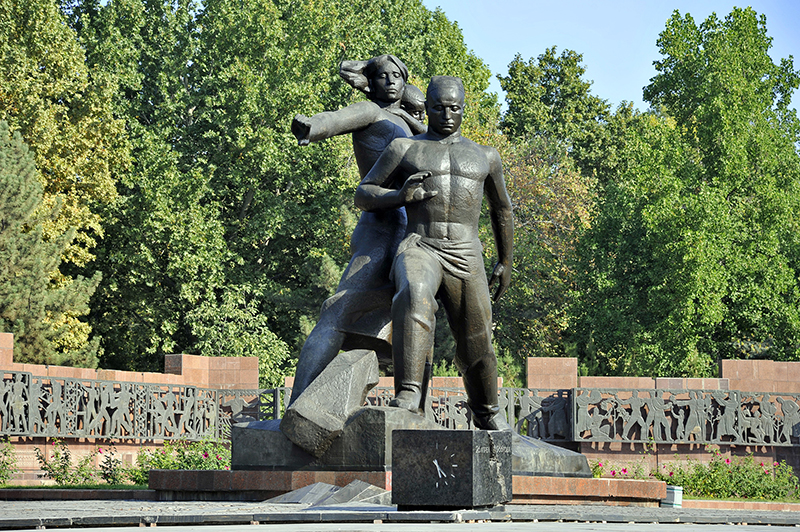
In the northern part of the city center stands an unusual black cube, split by a deep crack. Out of it a bronze family seems to emerge — a man, a woman and a child.
This is the Monument of Courage, dedicated to the Tashkent earthquake of April 26, 1966, and to the people who survived the disaster and then rebuilt the city together. Today it's considered one of the most recognizable memorials in Tashkent.
But it's interesting not only as a monument to tragedy.
The monument tells the story of how, after a single morning, Tashkent effectively had to be built anew.
What happened on April 26, 1966
It was 5:23 in the morning.
Most of the city was still asleep when a powerful earthquake struck Tashkent. The central district of the capital was hit especially hard. Thousands of buildings were destroyed or seriously damaged, and more than 300,000 people were left homeless.
People had to live in temporary tent settlements, and the city faced a colossal task: rebuilding housing, roads, schools, hospitals and the entire urban infrastructure.
But alongside the tragedy came an unprecedented reconstruction campaign for the city.
Builders, engineers and specialists came to Tashkent from across the Soviet Union's republics. A new city began to rise literally on the site of the old one that had been destroyed.
It's precisely this story — not just about the earthquake, but about rebuilding — that lies at the heart of the Monument of Courage's idea.
Why the monument shows the time 5:23
One of the monument's most striking details is a black stone cube.
On one side is written the date:
April 26, 1966.
On the other is a clock face with its hands stopped at 5:23, the moment the devastating earthquake began.
The cube looks as if it has been split in two.
The crack runs across its surface and continues along the ground, leading toward the bronze group.
It's one of the monument's most powerful symbols: the earth split open, ordinary life came to a halt — but the city's story didn't end there.
The black cube and the family
The composition's second part consists of bronze figures of a man, a woman and a child.
The woman clutches the child to herself, while the man seems to shield them with his body from the danger closing in.
This isn't a depiction of a specific family. What we see is a symbol of ordinary city residents caught at the heart of the disaster.
And it's here that the contrast works especially well.
Behind — the cold, heavy black cube.
In front — living human figures.
So the monument speaks not only about destruction, but above all about a person who proved stronger than circumstance.
Why the monument is called "Courage"
The name wasn't chosen by chance.
The monument is dedicated not only to the memory of the dead and the destroyed city. Its central idea is resilience, courage, mutual aid and the rebuilding of Tashkent.
This is especially important to understand when looking at the composition as a whole.
There's no sense of hopelessness here.
Yes, the earth is split open.
But out of that crack begins a movement forward — toward the human figures, and further still, toward the reliefs dedicated to the city's reconstruction.
14 steles continue the story
Behind the main sculpture stand 14 steles with bas-reliefs.
If the central part of the monument tells of the moment of tragedy, the reliefs show what came after it: the work of builders, the rebuilding of structures, and the help of people who came to Tashkent.
That's why it's better to view the monument not from the front or from a distance, but to walk around it.
Only then does the full idea become clear.
First — the earthquake.
Then — the human being.
And then — the city's reconstruction.
Tashkent had to be rebuilt from scratch
The most striking thing about the Monument of Courage's story is that the earthquake changed not just the appearance of a few districts.
It changed Tashkent itself.
The destroyed quarters became the foundation for large-scale reconstruction, giving rise to new residential microdistricts, wide streets and major public spaces. The capital gained the architectural character that many tourists today perceive as distinctly Tashkent.
Much of the city's Soviet-era center took shape precisely in the period after the earthquake.
So walking through Tashkent today, it's worth remembering: many familiar buildings and entire districts arose as a result of the recovery from the 1966 disaster.
Why the Monument of Courage stands exactly here
The monument is located in the area of Abdulla Qodiriy and Sharaf Rashidov streets, in central Tashkent.
This isn't a random spot.
The monument stands in a district that was heavily affected by the earthquake and is linked to the disaster's epicentral zone. That's precisely why the monument reads here not as an abstract memorial, but as part of the real geography of the events.
Standing next to the monument, it's worth taking a look around.
Today this is a modern city — roads, high-rise buildings, green spaces.
But in 1966 this district looked completely different.
Who created the Monument of Courage
The sculptural composition's principal author was Dmitri Ryabichev. Soviet architects, including Sabir Adylov, took part in designing the complex's architectural elements.
For its time, the monument was quite bold.
Instead of a traditional depiction of heroes or political figures, the architects chose a strikingly concise form:
cube → crack → family → reliefs.
A handful of simple images tell an enormous story without long texts.
The Monument of Courage after reconstruction
In 2018, the area around the monument was redeveloped.
The square was improved, and the paving, lighting, steps and green zone were renewed. The bronze sculptures were also restored.
Thanks to this, today it's pleasant not only to look at the monument itself, but also to take a short walk around it.
In the evening the complex is especially striking: the lighting brings out the black stone, the figures and the surrounding space.
Interesting facts about the Monument of Courage
The earthquake struck at 5:23 in the morning on April 26, 1966. That exact time remains forever on the monument's stone cube.
More than 300,000 people were left homeless. For the city, this meant the need for a massive, near-total rebuilding of many districts.
A huge wave of help passed through Tashkent. Builders and specialists from various Soviet republics came to help rebuild the city.
The monument has 14 steles with bas-reliefs. They tell not of the disaster itself, but of Tashkent's reconstruction.
The monument is part of a larger memorial ensemble. Nearby, a space dedicated to the friendship of peoples and the rebuilding of the city was created during the Soviet era.
🎧 The Monument of Courage is only one of Tashkent's stories
You can walk up to the monument, take a photo and move on.
But then the main thing will remain unclear:
why precisely here did one of the most important turning points in modern Tashkent's history take place?
It's precisely here that our Tashkent tour begins (you can see a short clip from it here). We tell the city's story not as a set of separate sights.
The Monument of Courage helps you understand the 1966 earthquake.
Chorsu shows old trading Tashkent.
Hast-Imam shows the city's religious and cultural history.
And the modern districts show what Tashkent became after its large-scale reconstruction.
That's how individual places come together into one story of the city.
CityInsider is your local guide in your phone: listen to the stories right during your walk, move at your own pace, and don't miss the stories that simply can't be captured in a photo.