Tashkent Metro
The Tashkent Metro is more than just a way to get from point A to point B — it's a full-fledged attraction of the Uzbek capital. It was the first metro system in Central Asia, opening in 1977. Today the network has grown to more than 70 km of track and 50 stations, carrying over a million passengers every day.
Metro Lines of Tashkent
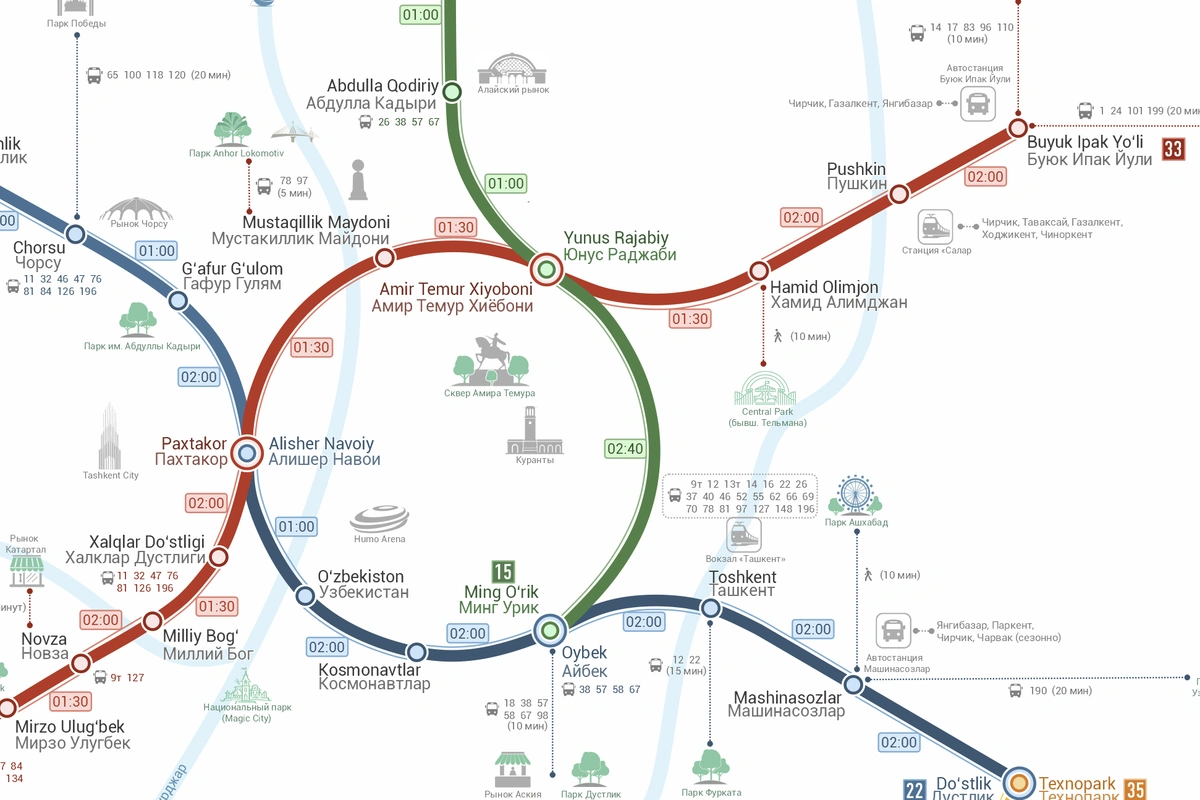
The network consists of several lines, each with its own color and character:
- Chilanzar Line (red) — the oldest line, opened in 1977. It's home to the most atmospheric Soviet-era stations, with marble, chandeliers, and mosaics.
- Uzbekistan Line (blue) — the second line to open, connecting the central districts.
- Yunusabad Line (green) — the youngest of the "classic" lines, with its first stations opening in 2001.
- Thirty Years of Independence of Uzbekistan Line — underwent major reconstruction and reopened at the end of 2025.
Transfer stations connect the lines, so you can reach almost any part of the city center without ever going above ground.
The Legend of the Man Who Built the Metro
Building the Tashkent Metro spawned as many legends as the mosaics on its station walls. The central figure in this story is Sharof Rashidov, First Secretary of the Communist Party of the Uzbek SSR. According to contemporaries, he petitioned Gosplan and Soviet party authorities 18 times before securing approval for construction — for more than a decade, Moscow considered a metro in earthquake-prone Tashkent impractical.
What finally tipped the decision wasn't just Rashidov's personal authority and persistence, but the work of scientists: engineers and seismologists developed a unique design rated to withstand earthquakes of up to magnitude 9 — Tashkent had already survived a devastating earthquake in 1966. These calculations became a decisive argument in negotiations with Moscow.
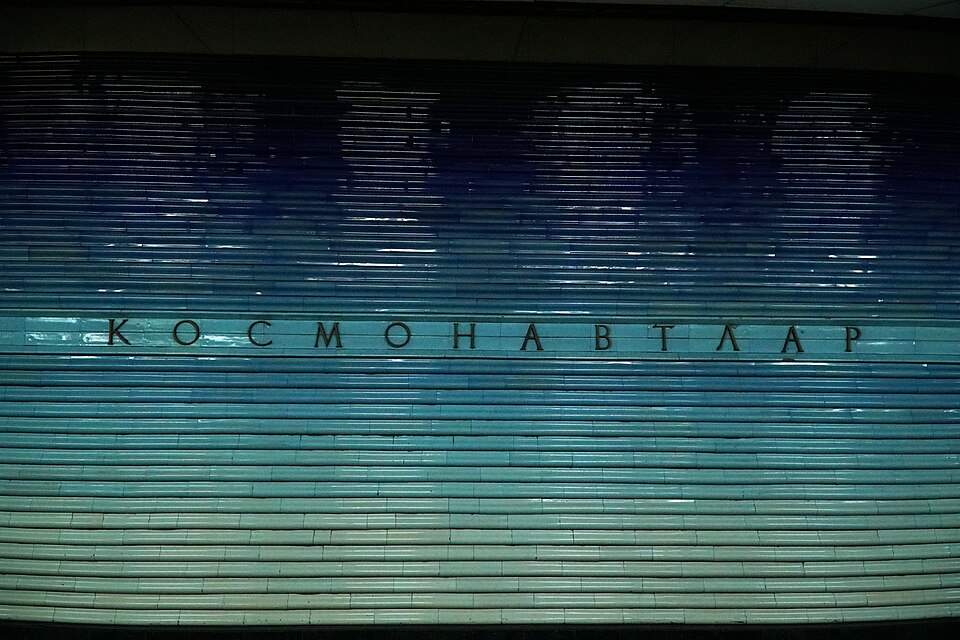
Rashidov didn't just push the project through — he personally approved the architectural design of every station. Out of 15 competing designs for Kosmonavtlar station, it was his choice that selected the futuristic concept by architect Sergo Sutyagin — the very design that's now considered the metro's signature look.
Yet a certain historical irony remains: despite Rashidov's decisive role in bringing the metro to life, not a single station bears his name today — something many Tashkent residents still consider unfair.
The Most Beautiful Stations — A Route for Photographers
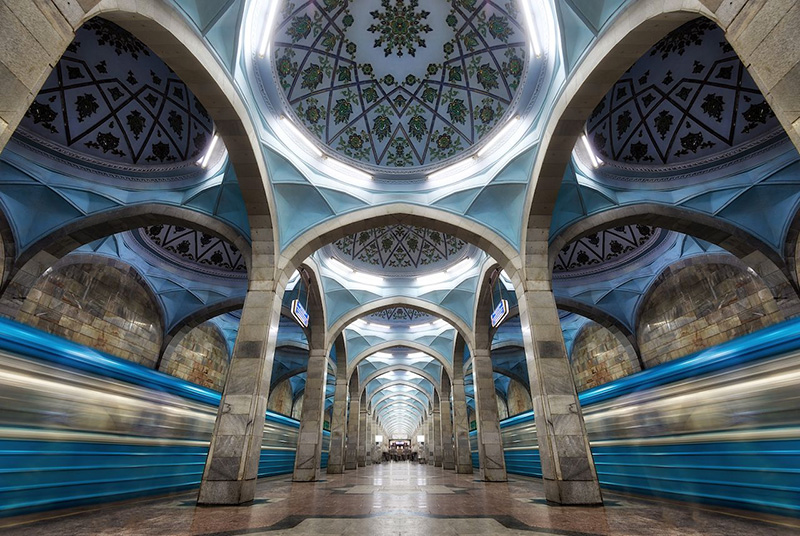
If the Tashkent Metro were judged as a museum, it would easily earn that status. Every station has its own individual design — created by some of the best artists of the Soviet era, and carefully preserved ever since:
- Alisher Navoi — designed like an Eastern mosque, with domes, niches, ornaments, and mosaics dedicated to the works of the great poet.
- Kosmonavtlar — a futuristic design featuring portraits of Soviet cosmonauts and Ulugbek, with blue tones and curved vaults that create the feeling of a spacecraft.
- Khamza (Novza) — an engineering rarity: built without supporting columns, with a single seamless vaulted ceiling that makes the hall feel especially spacious.
- Pakhtakor — dedicated to cotton, a symbol of Uzbekistan, with snow-white finishes and floral ornaments across the vaults and columns.
- Mustaqillik Maydoni — one of the most elegant stations, named after Independence Square, with a ceremonial, "grand" design.
- Stations on the Chilanzar Line — each with its own combination of marble, crystal chandeliers, and national ornamental patterns.
Tip: don't rush straight to the exit — riding a couple of extra stops on the Tashkent Metro is worth it for the architecture alone.
The Fastest and Most Convenient Way to Get Around the City
With its wide avenues and heavy car traffic, Tashkent's metro is arguably the fastest and most reliable way to get from one part of the city to another. While cars and taxis sit in traffic above ground, the metro gets you to your destination in minutes, right on schedule. For travelers, that's especially valuable — no need to build in extra "just in case" time, since the metro's schedule is easy to plan around.
Opening Hours
The metro runs daily from 5:00 AM to midnight (the Yunusabad Line opens later, at 6:00 AM). In the evening, around 11:00 PM, some stations stop admitting new passengers, so if you're planning a late stroll around the city, it's worth mapping out your route back in advance.
Practical Tips for Tourists
- Photography is now freely allowed in the metro — many tourists come to Tashkent specifically for a "metro tour."
- Signs and announcements are in both Uzbek and Russian, and major transfer stations also have signage in English.
- The metro is the fastest way to reach most of Tashkent's key attractions from the city center, bypassing traffic.
- If it's your first time in the city, it's easy to combine a metro ride with a walk through the Old City — the landmark stations and historic quarters are within walking distance of each other.