Shaykhantaur in Tashkent: History, the Mausoleum of Sheikh Khovendi at-Tahur and Tole bi
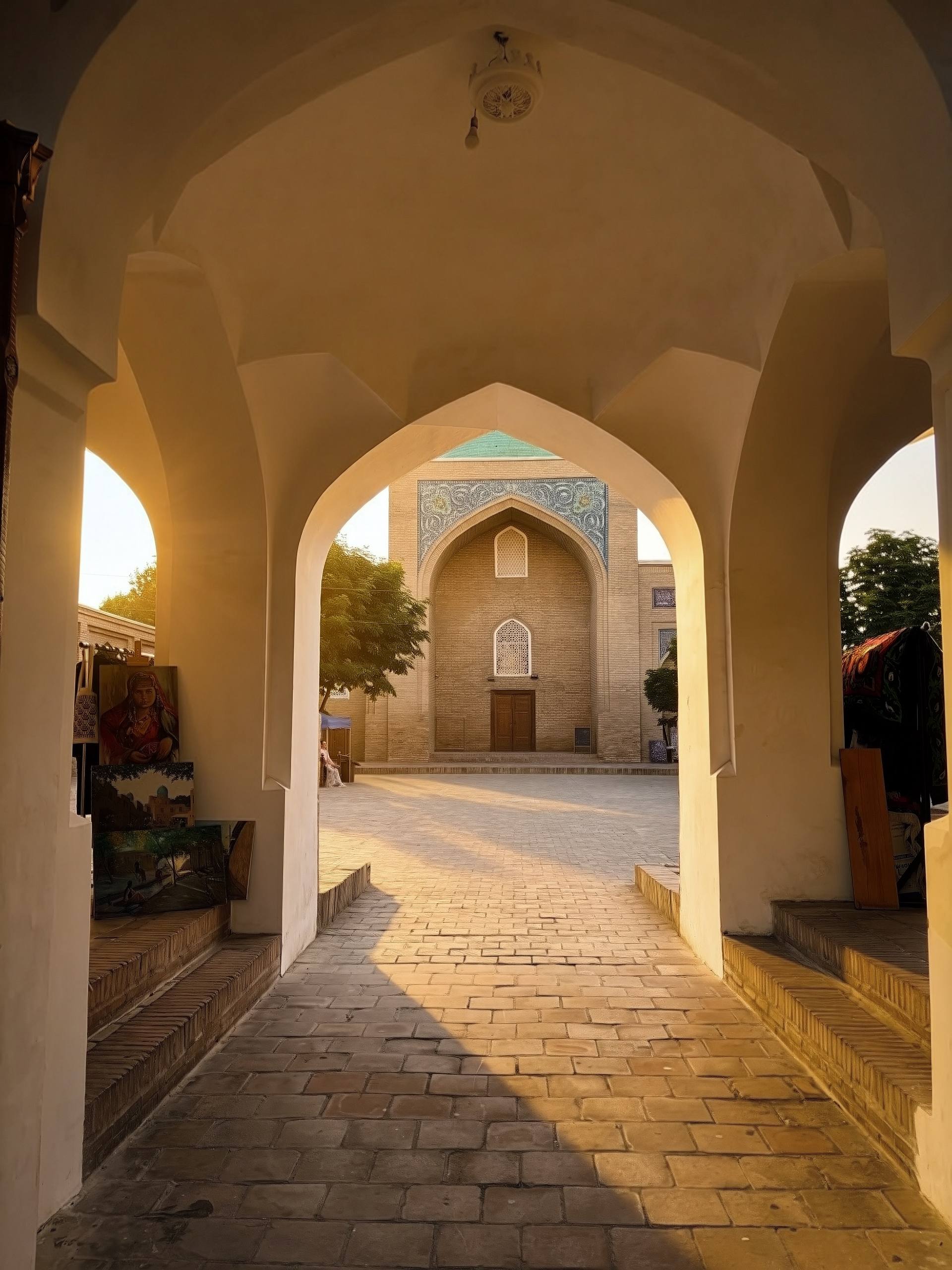
Between Abdulla Qodiriy Street and Alisher Navoi Street lies the Shaykhantaur memorial complex — one of the capital's important historical and spiritual monuments. It preserves the mausoleums of several outstanding figures connected with the history of Tashkent and Central Asia.
For visitors from Kazakhstan, this place holds special significance: it is home to the mausoleum of Tole bi, also known as Qaldyrgash bi. That's precisely why Shaykhantaur often becomes an essential stop for Kazakhstani travelers in Tashkent.
But the history of this site is far older than the mausoleum of Tole bi itself.
Where the name Shaykhantaur comes from
The name is linked to Sheikh Khovendi at-Tahur, a 14th-century Sufi teacher who was revered in Tashkent as the city's spiritual patron. He was born in Bogustan — an area that today lies near the Chorvoq reservoir — and came from a family connected to the religious tradition. In his youth he studied Sufi teachings, traveled widely, and later returned to Tashkent.
Sheikh Khovendi at-Tahur was linked to the tradition of Khoja Ahmad Yasawi, and his name has remained significant for Tashkent's spiritual history for centuries. According to the city portal, the sheikh died in 1355, having asked to be buried near a sacred spring.
After his death, the site gradually became a center of veneration, and an entire necropolis formed around the mausoleum.
Why the mausoleum was built here
The mausoleum of Sheikh Khovendi at-Tahur is tied to a story about Amir Timur.
According to local legend, Timur used the waters of a spring located here to treat an injured leg while in Tashkent, and ordered a mausoleum built over the sheikh's grave.
The original mausoleum dates to an earlier period, and the present building has been rebuilt many times. Sources indicate that today's monument took shape on the basis of a 15th-century mausoleum, with significant changes made later on.
Today the building looks fairly restrained from the outside: brick walls, a portal and domes. But inside, the space becomes much more expressive — you can see decorative niches, ornamentation and the dome structures characteristic of Central Asian architecture.
The "Chinar of Iskandar" — a tree with a legend
One of the mausoleum's most unusual features is a fragment of an ancient conifer known as the "Chinar of Iskandar."
According to legend, it is the remains of one of the trees planted by Alexander the Great, who is often called Iskandar in Eastern tradition.
The precise historical link between this tree and Alexander the Great has never been confirmed, so the story is best understood as an ancient local legend. Still, the relic has become one of the most famous features of the mausoleum of Sheikh Khovendi at-Tahur.
The mausoleum of Qaldyrgash bi — a site of special importance for Kazakhstan
Right nearby stands another monument — the mausoleum of Qaldyrgash bi, also known as the mausoleum of Tole bi.
Tole bi Alibekuly (1663–1756) was one of the most renowned biys and public figures in Kazakh history, a representative of the Senior Zhuz, an orator, and one of the authors of the legal code known as "Zhety Zhargy."
He played an important role in the political and public life of the Kazakh Khanate, and his name remains linked to ideas of justice, diplomacy and the art of resolving disputes.
After his death in 1756, Tole bi was buried in Tashkent, where a mausoleum was later built.
That is why this place holds special significance for Kazakhstani travelers.
Why the mausoleum of Tole bi looks unusual
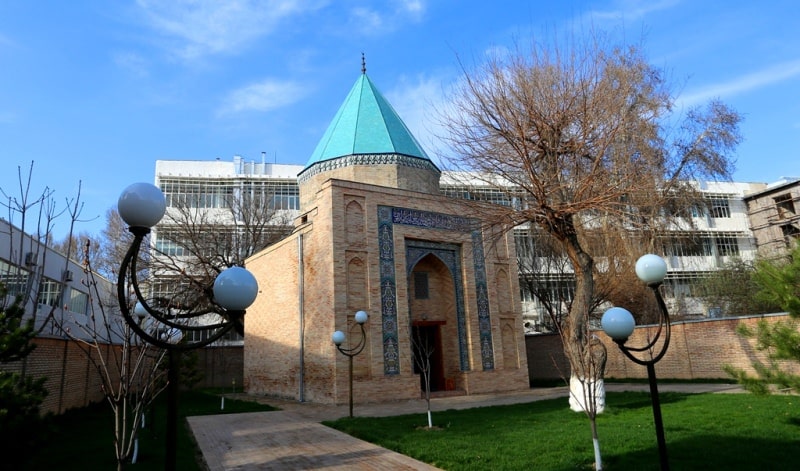
Qaldyrgash bi is easy to recognize by its unusual pointed tent-shaped dome.
Unlike the rounded blue domes typically seen in Tashkent, here a tall, multifaceted silhouette rises above the mausoleum. According to Visit Tashkent, the dome rests on a 12-sided drum and echoes forms characteristic of the funerary architecture of nomadic peoples.
It's precisely this architecture that makes the mausoleum so interesting: two traditions literally meet here — the urban architecture of Movarounnahr and steppe culture.
The legend of the "Holy Swallow"
A well-known legend tied to Tole bi's name explains his epithet Qaldyrgash bi — "the Holy Swallow."
According to the story, during the Dzungar invasion Tole bi refused to leave his home because a swallow had built its nest under the roof of his house. He didn't want to destroy the nest and doom its chicks.
The details of this story can't be historically verified, but it has been preserved in folk memory across generations. Thanks to this legend, Tole bi became, in Kazakh tradition, a symbol of wisdom, foresight and respect for life.
What remains of old Shaykhantaur
The necropolis around the mausoleum was once far larger.
It contained the burials of rulers, spiritual leaders and noble Tashkent families. During the Soviet period, the historic necropolis was largely lost, and only a few of the most significant mausoleums have survived to this day.
Today, three mausoleums are recognized as part of the historic ensemble:
The mausoleum of Sheikh Khovendi at-Tahur
The complex's main shrine.
The mausoleum of Qaldyrgash bi (Tole bi)
A site of particular importance to Kazakhstani visitors.
The mausoleum of Yunus Khan
A monument of the Timurid era, located nearby but today within a closed area.
As a result, the site retains only part of its historic scale — but that's exactly why a walk here can feel like a discovery: behind the modern streets, a small fragment of old Tashkent unexpectedly comes into view.
Shaykhantaur and Kazakhstan: a place that unites history
For Kazakhstani tourists, Shaykhantaur is not just another historical landmark in Tashkent.
The mausoleum of Tole bi is a reminder of just how closely the histories of Central Asia's peoples have been intertwined. Political borders shifted, cities passed under the rule of different states, but trade routes, religious traditions, families and cultural ties continued to connect the region.
Today, Tashkent remains a place where this shared history can be seen literally within a few steps.
And perhaps that's exactly why Shaykhantaur is worth visiting unhurriedly.
What to see nearby
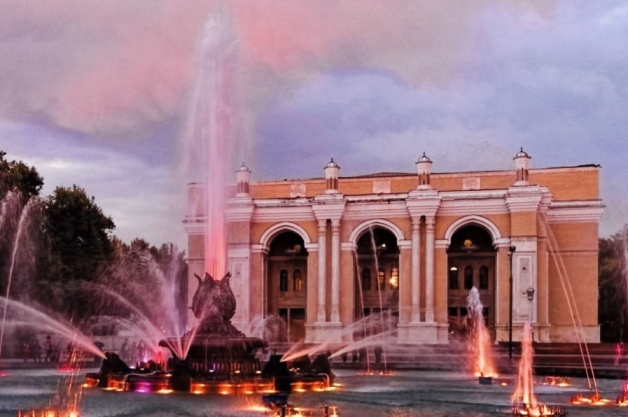
Shaykhantaur fits well into a walk through central Tashkent. It's located not far from the starting point of the CityInsider Tashkent tour. You can view the full route here. After visiting the complex, you can continue on to Amir Temur Square, the Navoi Theater, the Old City, or Chorsu. And if you're lucky, you can combine it with our group tour of the Old City of Tashkent and dive even deeper into the history of our city.
And if you'd like to see another side of Tashkent, the route can continue into the city's modern spaces — for example, the Center for Contemporary Art.